
Buy Now, Pay Later (BNPL) has outgrown its e-commerce origins to become a powerhouse retail acquisition driver inside physical brick-and-mortar storefronts across Malaysia.
With over 8 million Malaysian consumers actively utilizing digital installment options, shoppers across Klang Valley, Penang, and Johor Bahru expect flexible 0% interest splitting when purchasing footwear, consumer electronics, cosmetic packages, and designer apparel.
Yet, physical retailers often struggle with three systemic operational barriers:
- Terminal Clutter & Rental Overheads: Juggling distinct POS terminals or standalone bank EDC devices for each payment scheme creates counter friction and increases recurring monthly rental fees.
- MDR Reconciliation Headaches: Merchant Discount Rates (MDR)—ranging from 2.5% to 5.5%—complicate end-of-day bank reconciliations when gross sales figures fail to match net bank disbursements.
- Basket Abandonment at Checkout: When confronted with a lump-sum payment of RM600, customers frequently walk away, whereas a "3 x RM200" installment option closes the sale on the spot.
GeminiPOS Unified In-Store BNPL consolidates dynamic QR installment generation straight onto your existing Android POS screen.
---
1. Technical Flow: Dynamic In-Store BNPL Processing
!Technical Architecture and Financial Settlement Flowchart for In-Store BNPL
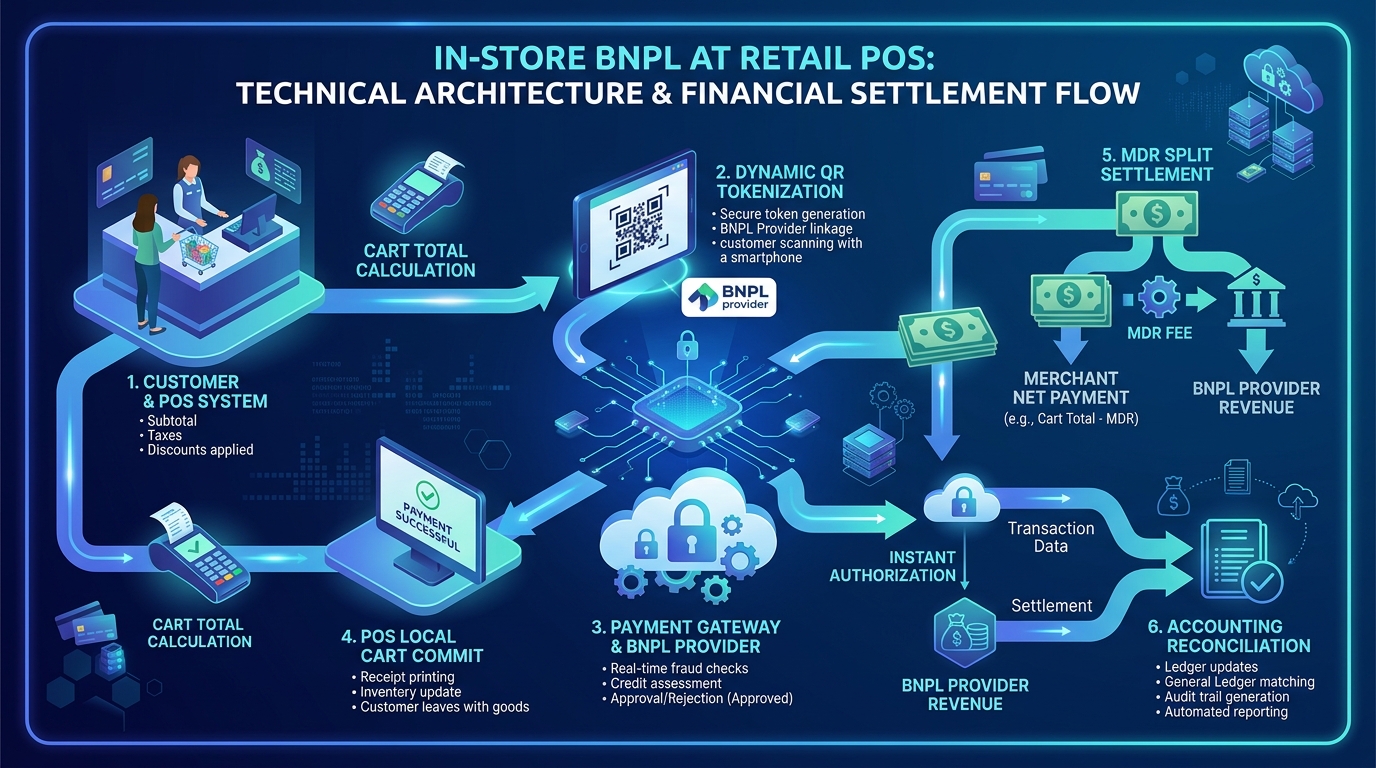
The end-to-end checkout sequence executes seamlessly within seconds:
- Order Total Calculation: The POS calculates the subtotal. If the basket meets the provider's threshold (e.g., above RM100), the BNPL tender method becomes available.
- Dynamic QR Tokenization: The terminal calls the payment gateway API to tokenize the cart amount, generating an authenticated, non-reusable dynamic QR code on the POS screen.
- Consumer Smartphone Authorization: The shopper scans the code using Grab, Atome, or SPayLater. Real-time credit checks authorize the transaction in milliseconds.
- Local Cart Commit & Receipt Printing: Upon receiving the cloud webhook confirmation, the Android POS updates inventory, commits the sale, and prints the fiscal receipt.
- Automated MDR Ledger Split: The merchant receives full payout (less MDR) directly into their bank account on a T+1 schedule, while GeminiPOS automatically books the processing fee into a distinct accounting ledger.
---
2. Performance Comparison: Full Payment vs In-Store BNPL
Benchmark Metric · Traditional Cash/Card Payment · Integrated GeminiPOS BNPL
Average Order Value (AOV) · RM90 – RM140 · RM240 – RM480 (+45% to +60% uplift)
Checkout Conversion Rate · High hesitation on big-ticket items · Frictionless impulse decision-making
Hardware Overhead · Multiple bulky EDC card machines · Single multi-functional Android POS terminal
Credit Default Risk · Peniaga carries risk if offering credit · Zero merchant liability (BNPL provider assumes risk)
Financial Reconciliation · Tedious manual cross-checking · Automated gross sales vs net payout journal entries
---
3. Regulatory Safeguards: Consumer Credit Commission (SKP) Alignment
In strict alignment with Malaysia's evolving Consumer Credit Act (CCA) and guidelines from the Consumer Credit Oversight Board (CCOB / SKP):
- Clear Cost Breakdown: Monthly repayment schedules are explicitly communicated to the consumer prior to PIN authorization.
- Transparent Pricing: No additional checkout surcharges are levied on customers choosing BNPL schemes.
- LHDN e-Invoice Ready: The full transaction value is registered immediately for statutory LHDN e-Invoicing compliance upon purchase completion.
Unlock higher ticket sizes and capture tech-savvy shoppers with integrated in-store BNPL on GeminiPOS.
---
> 💡 Related Guide: Discover the complete feature overview, local-first offline architecture, and multi-outlet workflows of our flagship POS system in Malaysia built for modern retail and F&B businesses.