
For decades, enterprise retail supply chains have been throttled by static replenishment algorithms: simplistic min/max thresholds, static reorder points (*ROP*), and cumbersome periodic reviews.
These legacy heuristics are fundamentally broken in modern omnichannel retail:
- They ignore non-linear demand spikes caused by social media trends and micro-seasons.
- They fail to dynamically model vendor variability and logistical friction.
- They treat inventory as a passive ledger entry rather than an active velocity asset.
The emergence of Agentic AI—autonomous systems capable of perceiving environmental state, reasoning across constraints, and executing operational actions—is revolutionizing retail operations at the point of sale.
---
1. The Architectural Shift: Heuristic Rules vs. Agentic Intelligence
In a next-generation retail ecosystem, the register is no longer just an endpoint that captures payments; it functions as a distributed sensor grid feeding an autonomous replenishment loop:
!Agentic AI in Enterprise Retail Operations Diagram
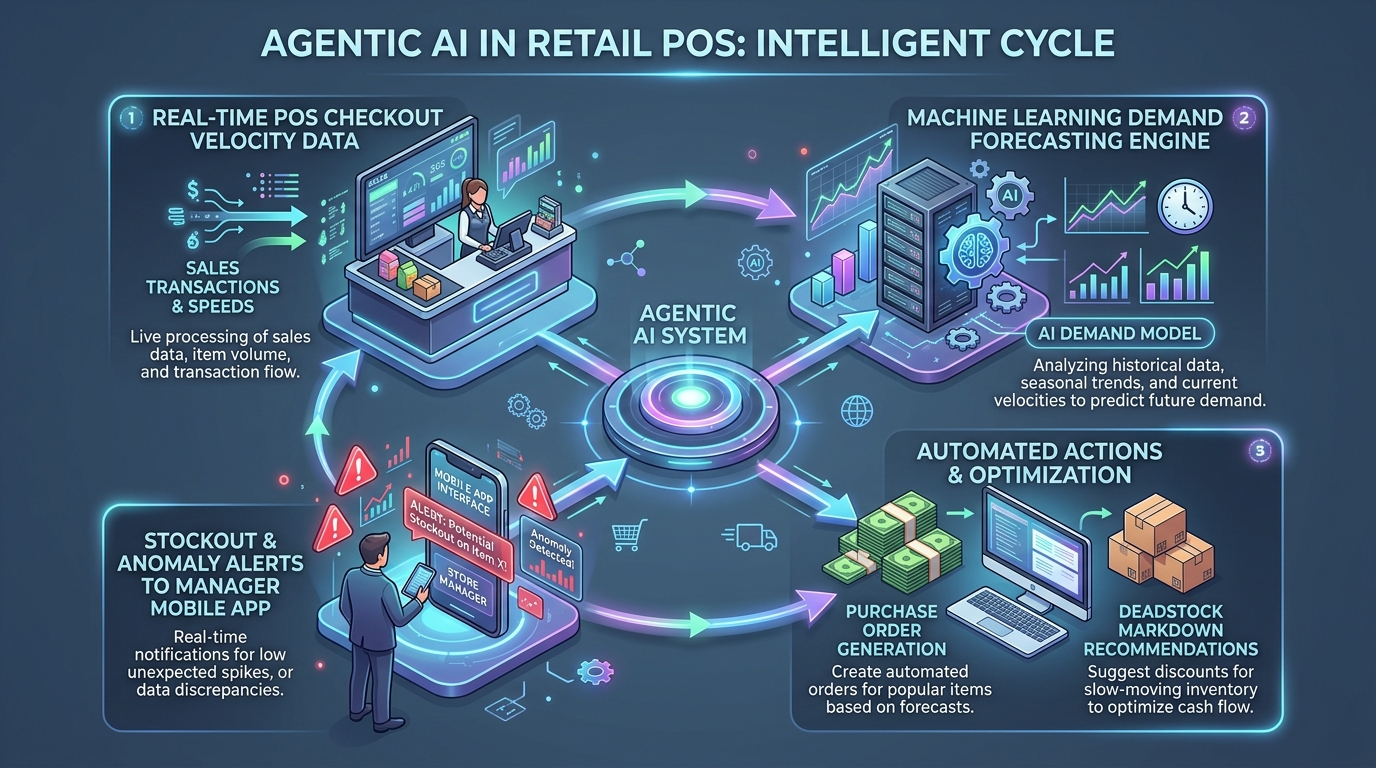
1. Velocity-Weighted Edge Ingestion
Every item scanned at the counter updates dynamic velocity vectors across time-decay windows (1-hour, 24-hour, 7-day, 30-day velocity). The model monitors acceleration gradients, identifying emerging product velocity surges hours before standard reports reflect them.
2. Multi-Echelon Stochastic Forecasting
Rather than calculating a deterministic single-number forecast, the agentic engine executes stochastic simulations incorporating:
- Lead-time variance: Historical supplier punctuality under differing freight conditions.
- Cross-elasticity & Cannibalization: How discounting Brand A impacts the sales velocity of Brand B.
- Basket Co-occurrence: Probabilistic demand cascades (*e.g., purchasing item X triggers a 72% likelihood of purchasing item Y*).
3. Closed-Loop Autonomous PO Execution
When the probabilistic risk of stockout crosses a configured confidence threshold, the agent does not merely flash an alert on an administrative screen—it compiles, validates, and stages the EDI or API purchase order directly to the distribution center or direct-store-delivery (DSD) supplier.
---
2. Technical Capabilities Matrix
Architectural Dimension · Legacy Heuristic ERP / POS · Agentic AI Architecture (GeminiPOS)
Replenishment Trigger · Static threshold crossed (*Quantity < Min*) · Dynamic velocity gradient & stochastic risk curve
Lead Time Modeling · Assumed static integer (*e.g., always 3 days*) · Bayesian probability distribution over historical vendor performance
Deadstock Remediation · Discovered months later during physical audit · Continuous early-warning trigger at 21-day velocity decay
Purchase Order Pipeline · Manual data compilation by inventory buyers · Automated self-assembling PO drafts with single-touch sign-off
Inter-Store Rebalancing · Manual, ad-hoc branch transfers · Algorithmic rebalancing suggestions between regional nodes
---
3. Measurable Impact on Enterprise Retail Balance Sheets
Deploying autonomous demand forecasting delivers immediate, quantifiable balance sheet improvements:
- Eradication of Phantom Stockouts: Eliminates discrepancy between registered digital stock and empty physical shelf space through velocity anomaly detection.
- Working Capital Optimization: Reduces overall safety stock holding requirements by 25% to 35% without degrading on-shelf customer fulfillment rates.
- Reduction in Food Waste and Perishables: In grocery and convenience sectors, predictive consumption models cut expiration write-downs by over 40%.
---
4. Conclusion & Enterprise Architecture Advisory
Point of sale infrastructure can no longer remain isolated from predictive intelligence. By unifying front-line cashier transaction flow with agentic machine learning replenishment, enterprise retailers turn transactional data into autonomous operational resilience.
> Modernizing your enterprise retail inventory infrastructure?
> Explore how GeminiPOS combines distributed edge reliability with autonomous predictive intelligence.
> Review our Architectural Whitepaper or Contact our Enterprise Solutions Team.