
In the global apparel, footwear, and accessory retail sector, product complexity expands exponentially rather than linearly. Unlike supermarkets dealing primarily with static single-SKU barcodes, fashion merchandisers operate within the multidimensional architecture of Matrix Variants.
A single garment design rarely enters an inventory catalog in isolation:
- A new overcoat or tailored blazer might launch across 5 standard sizes (XS through XL).
- It is distributed across 6 colorways (Charcoal, Camel, Olive, Ivory, Navy, and Black).
- Under this standard profile, a single design immediately spawns 30 individual child SKUs, each requiring distinct inventory thresholds, physical shelf allocations, and separate tracking.
Retailers managing fashion lines via generic spreadsheets or legacy single-tier POS systems inevitably experience operational collapse: cashiers scan a Small when selling an Extra Large, bestselling sizes run out undetected, and store associates lose substantial selling floor time searching disorganized stockrooms.
---
1. Systemic Friction Points in Fashion Inventory
- Barcode Cross-Contamination: When an untrained cashier scans a barcode belonging to another size of the same style, inventory ledger accuracy is instantly corrupted.
- Inflexible Tagging Infrastructure: Traditional methods require outsourcing hangtags to industrial print shops with long turnaround times and high MOQs. Price updates necessitate manual, unsightly markdown stickers.
- Omnichannel Fulfillment Disconnects: When physical stores and e-commerce platforms do not share an instantaneous matrix ledger, the final physical unit can easily be sold in-store while being purchased online simultaneously—resulting in costly order cancellation penalties.
---
2. Integrated Retail Matrix Workflow
The diagram below illustrates the end-to-end operational lifecycle of matrix inventory within GeminiPOS:
!Retail Matrix Inventory Workflow Diagram
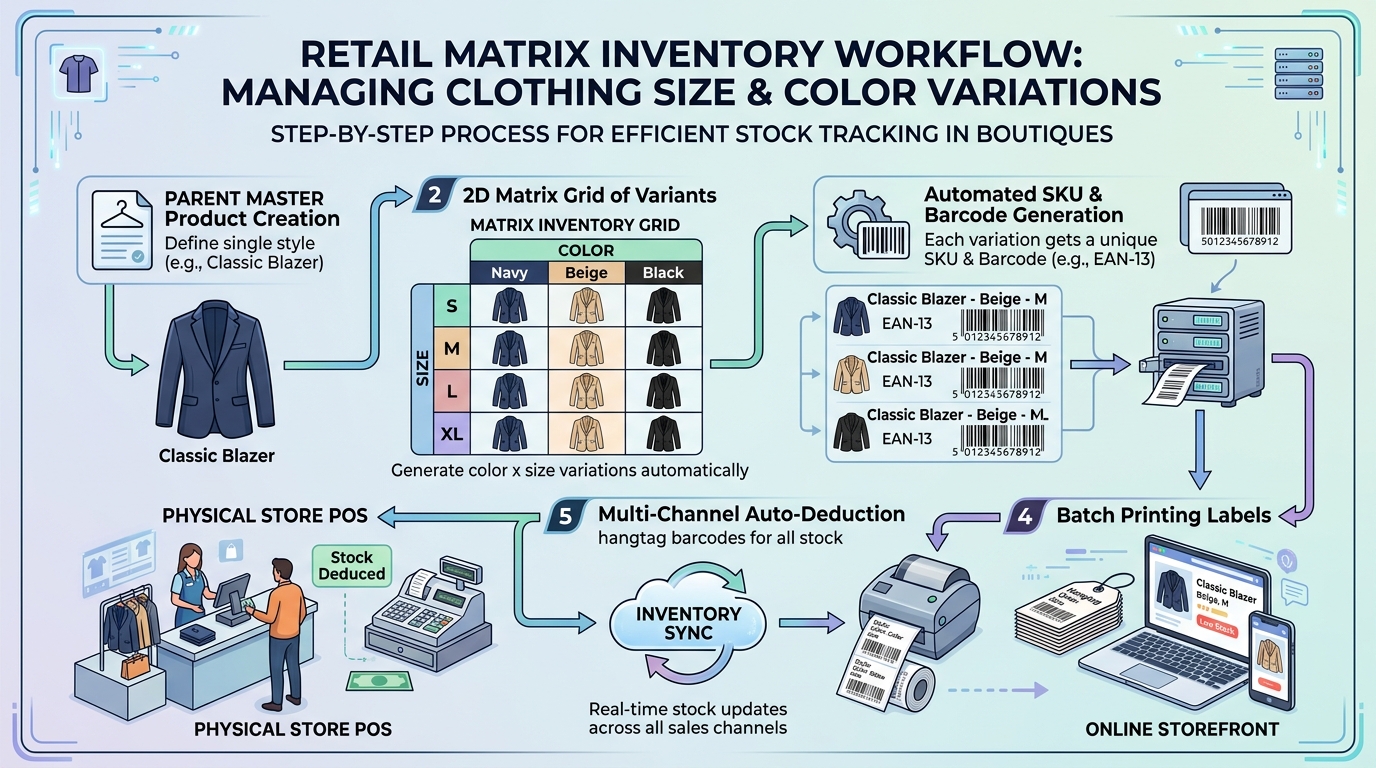
Stage 1: Parent Master Product Configuration
Establish the master design profile once (e.g., *"Classic Blazer"*), setting global retail pricing, fabric composition, and supplier baseline costs.
Stage 2: 2D Matrix Generation (Size x Color Grid)
Specify active size runs and color attributes. The GeminiPOS engine programmatically spawns all 30 child SKU variations in a single operation, assigning unique item identifiers.
Stage 3: Automated Unique Barcode Generation
Each permutation receives a dedicated, non-overlapping EAN-13/UPC barcode, making checkout ringing foolproof across all cashiers.
Stage 4: On-Demand Hangtag Printing
Using standard TSPL label protocols, the Android POS pairs directly with thermal label printers to batch-print professional price hangtags and adhesive barcode stickers on demand.
Stage 5: Multi-Channel Auto-Deduction
Physical register transactions immediately decrement branch stock and push real-time availability updates across connected online storefronts.
---
3. Generic POS vs. Dedicated Apparel Matrix POS
Operational Vector · Standard Generic POS · GeminiPOS Fashion & Apparel Engine
Cataloging 30 Variants · Tedious manual entry of 30 separate records · Single-click 2D matrix generation
Register UX · Long, unwieldy scrolling text lists · Intuitive visual Color-by-Size matrix grid
Barcode Tag Production · Requires separate PC desktop utilities · Native thermal label printing directly from Android till
Multi-Location Balancing · Phone coordination and spreadsheet audits · Formal digital Transfer Orders with audit trails
Network Resilience · Web interfaces freeze during WAN drops · Fully offline-capable SQLite database architecture
---
4. Seasonal Markdown Agility & End-of-Season Sales (EOSS)
Fashion lifecycles demand rapid clearance agility. With GeminiPOS:
- Variant-Targeted Markdown Rules: Apply targeted promotional markdowns to slow-moving fringe sizes (e.g., 40% off XS only) while preserving full gross margin on high-velocity core sizes.
- Mix & Match Promotional Bundles: Deploy multi-item combo discounts (e.g., *"Select any 2 knitwear pieces for $120"*) calculated dynamically at the register without manual cashier math.
---
5. Summary & Strategic Next Steps
Apparel retail success hinges on brand identity and customer connection—not manual inventory reconciliations in backroom stockrooms.
> Ready to modernize your clothing or footwear retail operations?
> Explore how GeminiPOS empowers growing fashion brands with matrix inventory precision.
> Contact Our Solutions Team or explore our Multi-Store Inventory Capabilities.