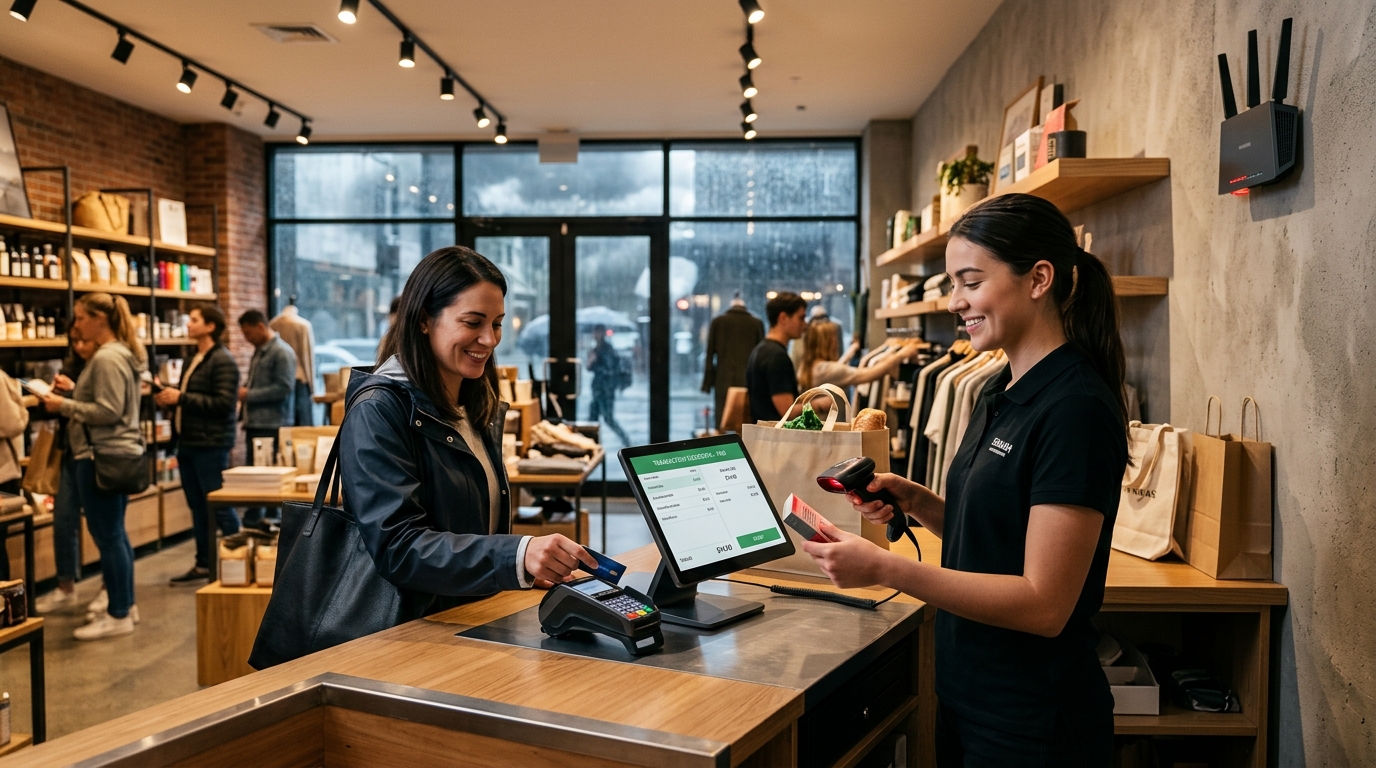
Across high-volume retail, fast-casual hospitality, and global pop-up merchandising, operators are repeatedly victimized by a pervasive technological vulnerability: the catastrophic failure of browser-based Web-Cloud POS registers during telecommunication disruptions.
The failure mode is devastatingly consistent:
- During peak customer footfall, wide-area ISP fiber cuts, cellular tower congestion, or local Wi-Fi router freezes abruptly sever internet access.
- Registers built on client-server web architectures render infinite loading spinners or abort checkouts with cryptic HTTP 504 Gateway errors.
- Cashiers cannot ring up baskets, calculate tax, or trigger physical receipt printers. Lines stall, customer sentiment plummets, and merchants hemorrhage gross margin.
This systemic fragility stems from an architectural anti-pattern: treating a physical checkout register as a dumb browser terminal that must execute a remote cloud round-trip for every single barcode scan.
The architectural paradigm that renders checkout counters impervious to network outages is Local-First Software, engineered with Embedded SQLite and Bi-Directional PowerSync Streaming.
---
1. Architectural Paradigms: Fragile Web-Cloud vs. Local-First Edge
The fundamental distinction lies in where transactional authority resides:
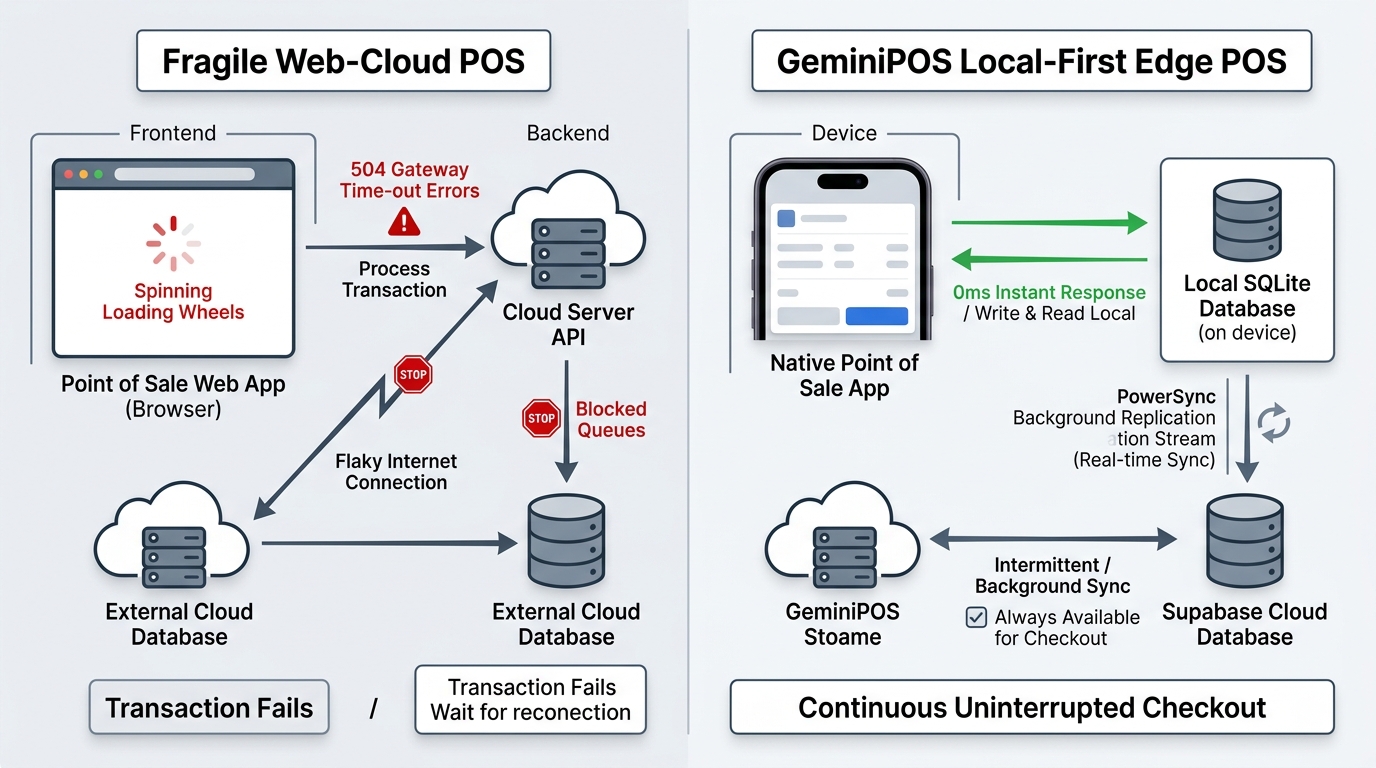
!Architectural Comparison: Fragile Web Cloud POS vs GeminiPOS Local-First Edge POS
The Fragile Paradigm: Web-Cloud POS (Remote-Dependent)
In conventional cloud POS architectures:
- The cashier taps "Complete Sale".
- The browser initiates an HTTP POST request across wide-area networks to a distant database instance.
- If the network experiences latency spikes or drops, the thread blocks.
- The entire physical register locks up, completely halting revenue collection.
The Resilient Paradigm: GeminiPOS Local-First (Edge-Autonomous)
In GeminiPOS's native Local-First architecture:
- 0ms Local SQLite Commit: The transactional payload commits instantly to an embedded, on-device SQLite database. Transactions finalize in sub-5 milliseconds with zero network dependency.
- Asynchronous PowerSync Replication: An intelligent background daemon continuously monitors network availability. When connectivity is present, transactions stream asynchronously to the central Supabase PostgreSQL cloud backend. If connectivity vanishes, the register continues operating indefinitely without interruption.
---
2. Why SQLite + PowerSync Outclasses Superficial "Offline Caching"
Many web-based software vendors tout rudimentary *"offline capabilities"*, which typically rely on ephemeral browser IndexedDB or LocalStorage buffers. These approaches routinely fail upon browser tab closure and trigger disastrous data collisions upon reconnection.
GeminiPOS implements enterprise-grade database replication:
- Full Relational Queries at the Edge: Cashiers can query 50,000 SKUs, evaluate complex promotional rules, verify customer loyalty ledgers, and execute split tenders entirely offline.
- Deterministic Conflict-Free Resolution: When multiple registers operate concurrently in detached offline environments, transactional timestamping and deterministic state reconciliation guarantee zero financial or inventory discrepancy when rejoining the cloud cluster.
- Minimal Hardware Overhead: Unlike resource-hungry web browsers executing multi-megabyte JavaScript bundles, native SQLite execution sips battery and memory, ensuring blistering responsiveness even on low-cost handheld POS hardware.
---
3. Operational Performance Benchmark
Reliability Metric · Legacy Web-Cloud Register · GeminiPOS Local-First (SQLite + PowerSync)
Scan-to-Cart Latency · 600ms – 2,500ms (network-dependent) · 0ms – 5ms (hardware-level on-device)
Response to Network Drop · Hard failure, frozen UI, lost sales · 100% operational continuity
Data Integrity During Power Loss · High risk of orphaned state · Strict ACID compliance on local storage
Remote / Outdoor Merchandising · Extremely fragile on weak cellular links · Flawless execution anywhere on the planet
Peak-Hour Concurrency · Slows during cloud multi-tenant load · Constant uncompromised edge throughput
---
4. The First Principle of Retail Point of Sale
A physical point of sale terminal is critical infrastructure. Under no circumstances should a register require permission from a distant data center just to accept payment from a customer standing in your store.
Local-First design marries the speed, tactile reliability, and resilience of traditional cash registers with the modern multi-outlet intelligence of the cloud.
---
5. Summary & Enterprise Evaluation
Do not allow fragile cloud architectures to compromise your store operations. Upgrading to Local-First point of sale infrastructure insulates your business against ISP outages, eliminates cashier latency, and safeguards every transaction.
> Evaluating resilient, mission-critical POS architecture for your retail enterprise?
> Explore how GeminiPOS powers multi-outlet retailers with unbreakable Local-First reliability.
> Contact our Solutions Architects or review our Technical Specifications.