When enterprise merchants and expanding retail chains evaluate point-of-sale platforms, incumbent solutions like Toast POS and Square POS dominate initial brand awareness.
Behind the marketing, enterprise retail operators and international multi-unit franchisees should look closely at a few structural questions before committing:
- Payment Processing Terms: Confirm directly with the vendor whether software licensing is tied to their own payment processing, and what the current transaction rates are — these vary by plan and are published on each vendor's own pricing page.
- Hardware Procurement: Check whether the vendor requires purchase of branded terminals, or whether the software can run on commodity Android hardware.
- Offline Processing Behavior: Ask the vendor directly what happens to a transaction if connectivity drops — whether there is a time limit on stored offline transactions and who bears the risk if a card is later declined.
This technical paper analyzes the architectural advantages of decoupling point-of-sale software from any single payment rail, using an Open, Local-First Android POS stack as the comparison point.
---
1. Architectural Gating: Payment Flexibility and Hardware Choice
!Proprietary Hardware Lock-In vs Open Local-First Android POS Architecture
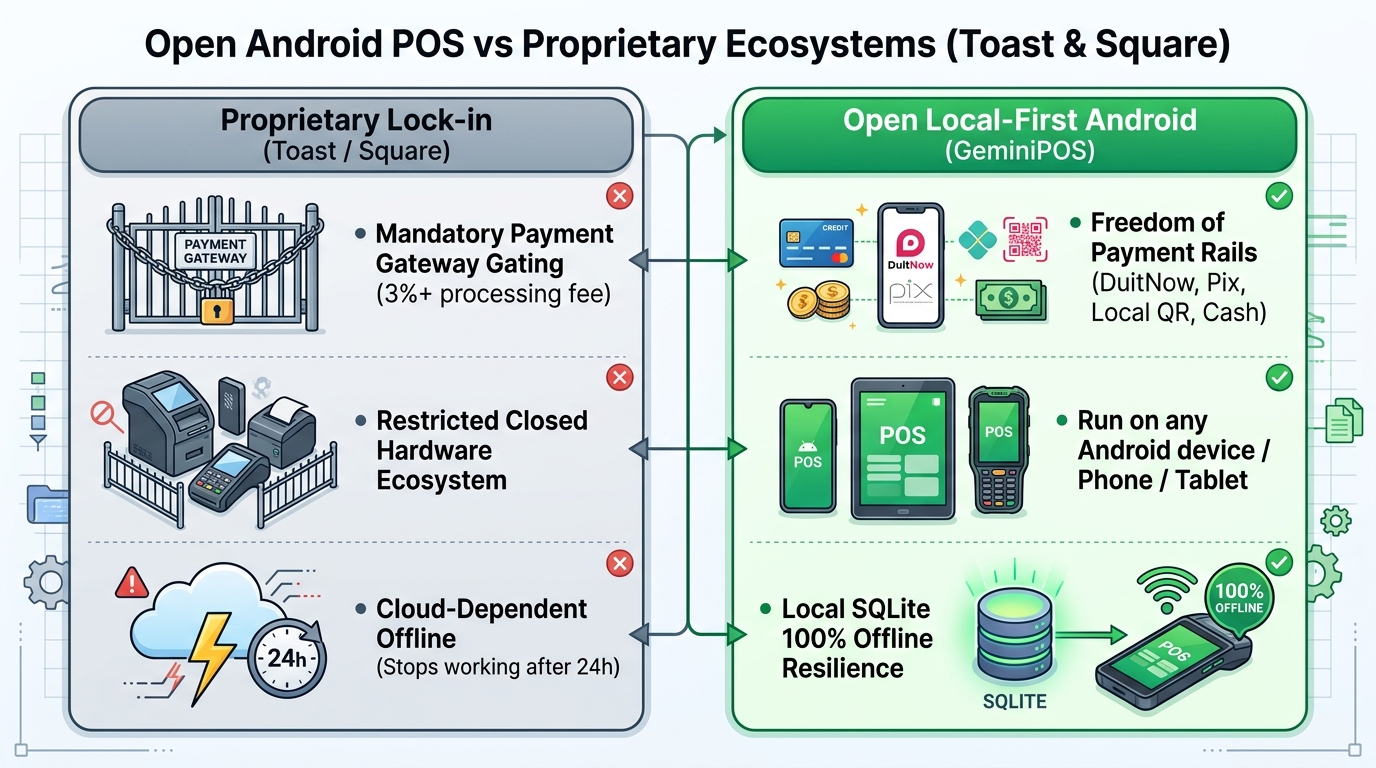
Many proprietary POS vendors bundle their software closely with their own payment processing. Before adopting any platform, enterprise buyers should verify, directly on the vendor's official pricing page:
- Processing Rate and Flexibility: What the current in-person and online processing rates are, and whether the merchant can route payments through an acquirer or bank terminal of their choice, or is required to use the vendor's own gateway.
- Regional Payment Rail Support: Whether the platform has native integration with the real-time payment rails used in your market (for example DuitNow, PIX, or UPI) — this differs by vendor and should be confirmed with their sales/support team rather than assumed.
The Open Architectural Alternative (GeminiPOS):
- Gateway Neutrality: POS software functions as an independent operating system. Operators interface with whichever acquiring bank, direct terminal merchant account, or local QR switch delivers optimal routing economics.
- Commodity Android Hardware Compatibility: The entire POS runtime compiles onto standard Android operating systems (API 26+), running equivalently on purpose-built dual-screen registers, industrial rugged handhelds, or standard commercial tablets.
- Pricing: GeminiPOS offers a free Starter plan, plus flat monthly Growth and Pro plans with no per-terminal surcharge (see geminipos.tech/pricing for current details).
---
2. Offline Resilience: Embedded SQLite vs Cloud Buffering
Cloud-reliant POS platforms generally depend on a working connection, or a time-boxed local cache, to keep operating during an internet outage. The exact offline behavior — how long transactions are held, and what happens on reconnect if a card is later declined — differs by vendor and plan, so confirm current details on the vendor's own support documentation rather than relying on third-party claims.
- The Local-First Architecture (GeminiPOS): By embedding a native SQLite relational database within the client terminal and synchronizing via PowerSync, transactions write synchronously to non-volatile local storage with no dependency on an active network connection at the moment of sale. Registers can function fully offline for extended periods, reconciling automatically upon reconnection.
---
3. Comparative Architecture Matrix
Architectural Parameter · Proprietary SaaS (Toast / Square) · Open Local-First (GeminiPOS)
Payment Acquirer Choice · Varies by plan — check current terms with the vendor · Acquirer Agnostic
Hardware Procurement · Primarily vendor-supplied hardware — check current device options · Any Commercial Android Hardware
Offline Transaction Model · Varies by plan — check vendor's offline-mode documentation · Synchronous embedded SQLite, no connectivity required at point of sale
Kitchen Orchestration (KDS) · Often vendor-specific hardware — check current options · Standard web browser on any Smart TV
Peripheral Bus Interfaces · Varies by vendor — check compatibility lists · Direct USB, Serial RS232, ESC/POS
---
4. Architectural Summary
For growing multi-lane retailers evaluating vendor lock-in risk, an open Android architecture is one way to gain hardware flexibility and offline reliability. Always verify a competing vendor's current pricing, processing rates, and offline-mode behavior directly on their official site before making a switching decision.