
In the rapid expansion of direct-to-consumer (DTC) brands into physical retail flagships, IT architects frequently attempt to standardize their point-of-sale estate around web-first technologies—most notably Shopify POS or browser-based progressive web applications (PWAs).
While web technologies simplify initial deployment and share unified e-commerce business logic, subjecting web-first architectures to high-throughput physical checkout environments exposes severe operational bottlenecks:
- Network-Bound Scan Latency: Every barcode lookup incurs an HTTP/REST roundtrip latency between 800ms and 1,500ms.
- Event-Loop Blocking & UI Freezes: Complex cart reconciliations and DOM repaints degrade cashier interaction speed during multi-item scanning.
- Pervasive Offline Vulnerability: When broadband connections jitter or fail, browser session states stall, freezing checkout lines.
This technical engineering paper analyzes the structural differences between Web-First Cloud Architectures and Native Local-First Embedded SQLite Engines.
---
1. Latency Breakdown: Network Hop vs Silicon-Level Lookups
!Web-First POS Architecture vs Native Local-First Counter Engine Technical Comparison
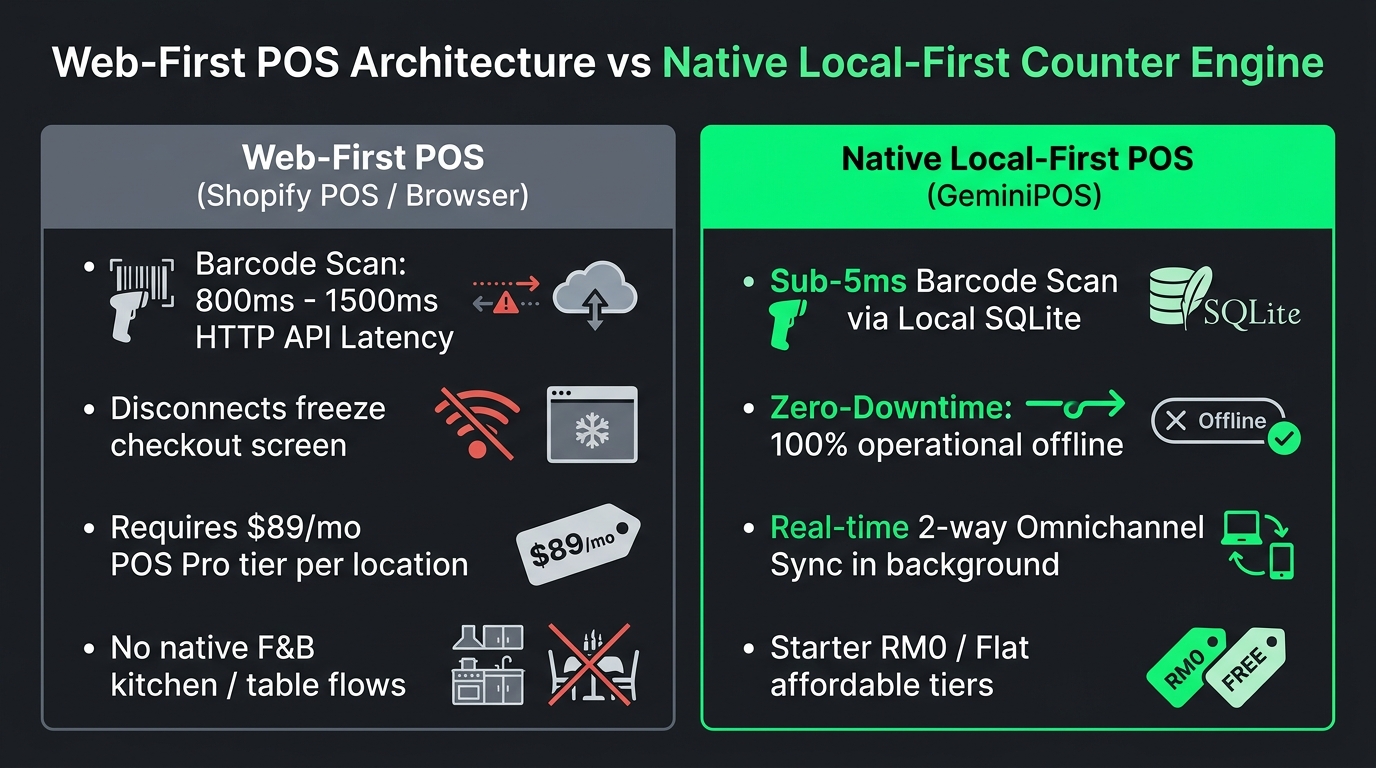
To understand counter queue performance, consider the mechanical lifecycle of an individual item scan:
The Web-First Cycle (Shopify POS / Browser Architecture)
In a retail scenario where a customer checks out 8 items, network latency alone consumes nearly 10 seconds of dead counter time.
The Local-First Cycle (GeminiPOS Native Android Engine)
By eliminating WAN network roundtrips entirely from the checkout critical path, native local-first architecture executes barcode registration over 200 times faster.
---
2. Fault Isolation & Offline Guarantee
In commercial shopping complexes and transit retail hubs, intermittent cellular and Wi-Fi packet drops are an operational inevitability.
- Web-First Fragility: Distributed caching via service workers or indexedDB provides rudimentary read-only catalogs, but transactions that mutate inventory or require split tenders frequently lock the UI until the socket reconnects.
- Local-First Determinism: With a local-first SQLite relational database embedded on the device (synchronized via PowerSync), all mutations commit locally first. Read and write operations never touch the network thread. Synchronization to the cloud runs asynchronously in a decoupled background worker. The cashier experiences zero difference in UI responsiveness regardless of whether the terminal is connected to fiber internet or completely off-grid.
---
3. Total Cost of Ownership: The "Location Tax"
Beyond latency and reliability, web-first cloud platforms extract escalating license tolls as physical footprint expands:
Parameter · Cloud Web-First (Shopify POS) · Native Local-First (GeminiPOS)
Scan Latency · 800ms – 1,500ms · < 5ms
Offline Transaction Execution · Fragile / Limited · 100% Deterministic SQLite
Software Cost per Lane · $89/month (Shopify POS Pro) · RM0 Starter / Flat affordable tiers
Hardware Compatibility · Closed iOS enclosures · Any Commercial Android hardware
Multichannel Stock Sync · Webstore focused · Real-time 2-way marketplace sync
---
4. Architectural Summary
For omnichannel retailers operating high-volume brick-and-mortar stores, checkout speed directly impacts customer sentiment and lane throughput. Decoupling the physical checkout engine from remote web servers via Native Local-First Android Architecture is the definitive engineering solution for retail resilience.