
"How are small retail businesses worldwide navigating the transition to mandatory, government-cleared digital invoicing?"
Across Europe (VAT in the Digital Age - ViDA), the Middle East (ZATCA Phase 2), and Southeast Asia (such as Malaysia's MyInvois CTC mandate), tax administrations are replacing retroactive tax audits with Continuous Transaction Control (CTC).
Under CTC regimes, governments require real-time or near-real-time digital clearance of commercial transactions. To shield micro-enterprises from severe operational shock, jurisdictions frequently calibrate turnover exemption thresholds (such as exempting businesses under specific annual turnover tiers).
However, navigating CTC exemptions presents acute architectural challenges for merchants. Here is how modern retail point-of-sale systems handle compliance without burdening store counters.
---
1. The Operational Friction of Tax Clearance at the Counter
When tax compliance requires server-side cryptographic signatures or government portal validation, conventional POS systems face three severe points of failure:
- Checkout Bottlenecks: A counter that must wait for government API clearance before printing a receipt experiences unacceptable latency during peak hours.
- Network Vulnerability: If the store internet drops or the government clearance gateway encounters downtime, pure cloud systems grind to a halt.
- The "Middleware Tax": Traditional software vendors charge hefty recurring subscriptions for API middleware adaptors to convert proprietary transactions into standard UBL/JSON formats.
---
2. Decoupled Clearance: Consolidated Invoicing & Buyer Self-Service
!Architecture of Decoupled Continuous Transaction Control at Retail Counter
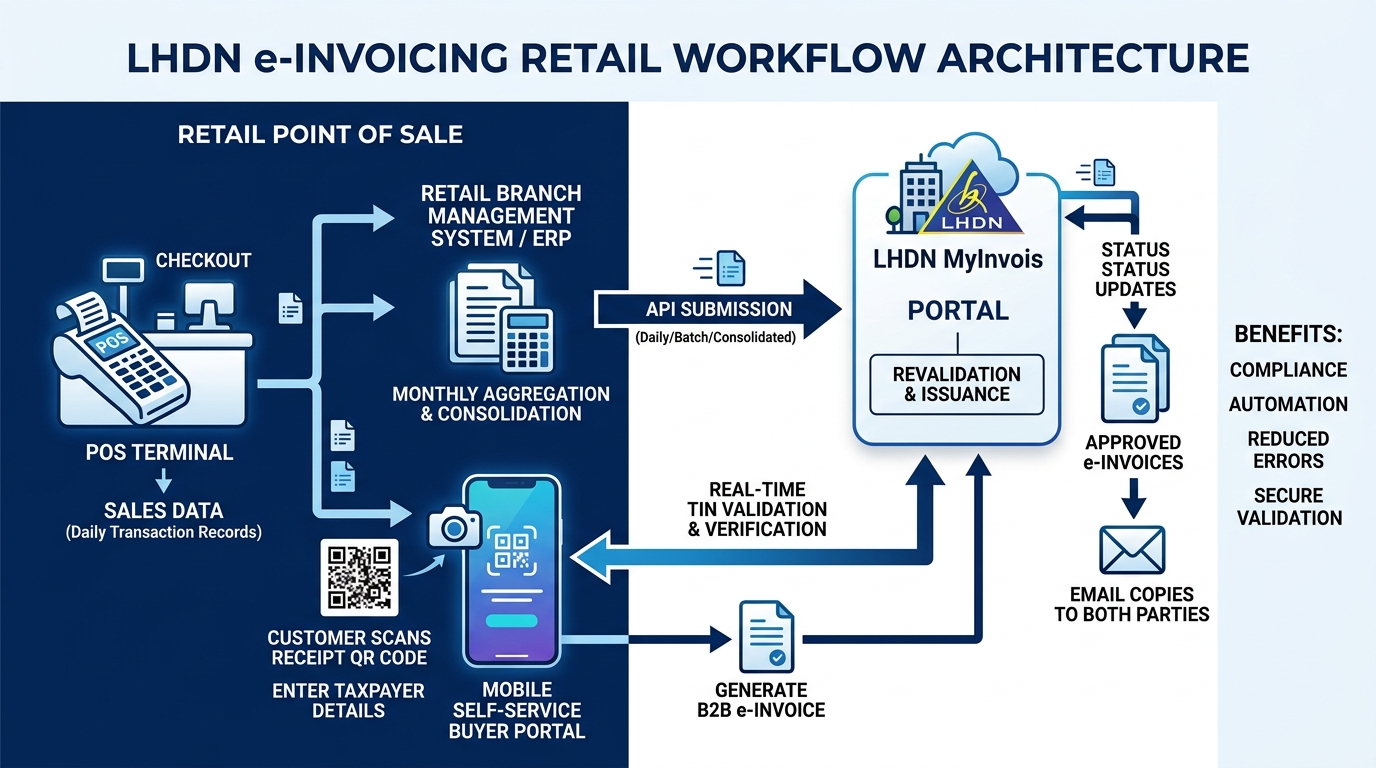
World-class retail architectures solve this via decoupled compliance workflows:
A. High-Volume B2C Consolidated Clearance
For standard retail walk-ins, the POS captures transactions locally in an offline-resilient store database. At periodic intervals (such as end-of-month), batched transactions are verified and submitted as a single Consolidated Electronic Clearance Document.
B. Buyer Self-Service QR
When a corporate or commercial buyer requires immediate tax-deductible clearance:
- The POS prints an immutable transaction verification token and QR code on the physical receipt.
- The buyer scans the receipt using their smartphone camera.
- The customer inputs their tax credentials into a hosted portal, which initiates the clearance request asynchronously with the tax portal.
- The frontline cashier is freed from cumbersome data entry, keeping counter queues moving at full speed.
---
3. Architectural Resilience with GeminiPOS
GeminiPOS implements native CTC tax handling directly inside its local-first SQLite and reactive synchronization engine:
- Zero Middleware: Standard XML and JSON payloads are compiled and verified natively on the device or via the free companion back-office.
- Offline Independence: Frontline sales never block on third-party clearance availability.
- Open Hardware Interoperability: Runs across off-the-shelf Android hardware, drastically reducing total cost of ownership for growing enterprises.
Explore GeminiPOS to bring resilient, zero-friction fiscal compliance to your retail infrastructure.