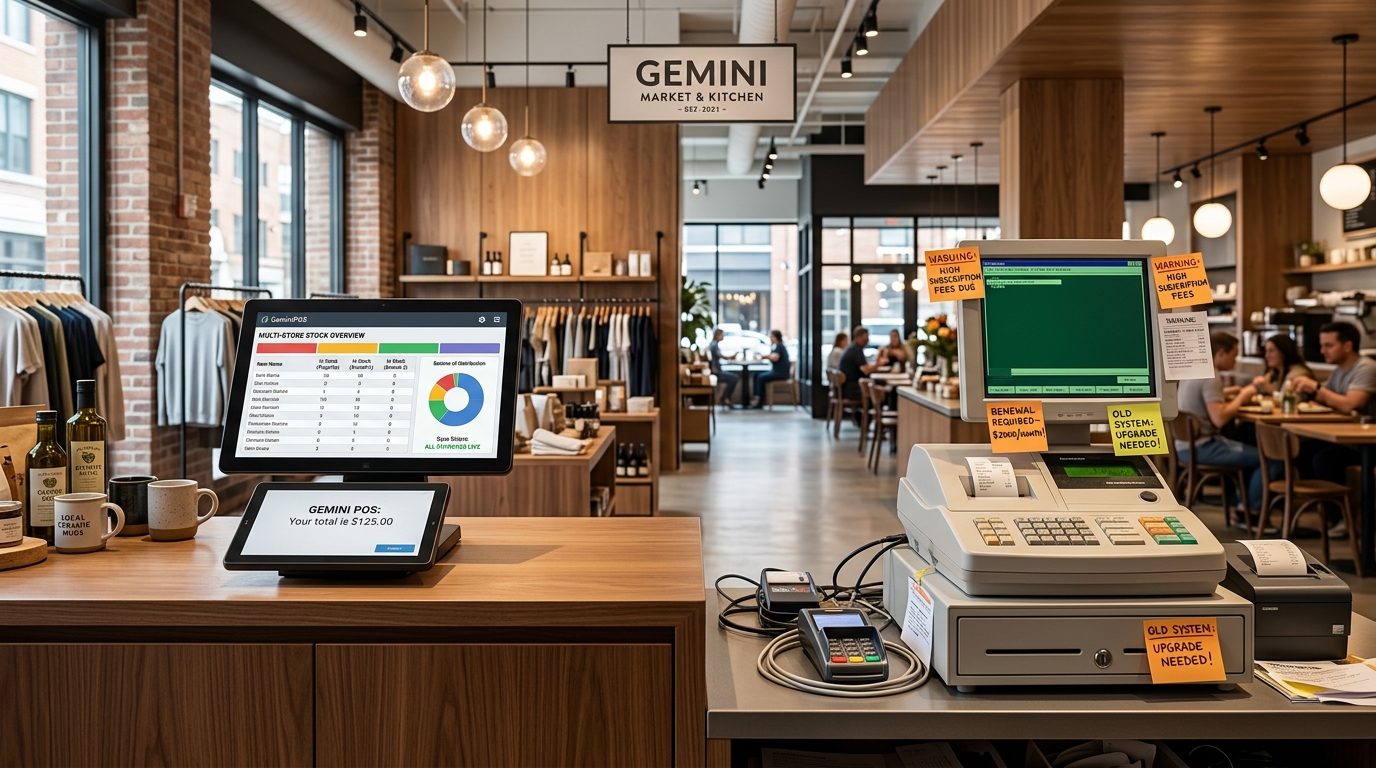
For multi-location retail chains and high-volume hospitality franchises, selecting a point-of-sale platform involves balancing feature completeness with enterprise Total Cost of Ownership (TCO). While Lightspeed POS has cemented itself as a major incumbent in the mid-market retail sector, scaling brands frequently experience structural architectural and economic constraints as their store fleet grows:
Watch (55 s): Switching from Lightspeed? Price, payments, contracts, kitchen display, hardware, extra counters and built-in accounting, compared for retail and restaurants.
Switching from Lightspeed? Compare costs with GeminiPOS
- Compounding Per-Register Licensing: Traditional enterprise POS subscriptions bill per active register or location, plus paid add-ons for advanced inventory, accounting, and loyalty modules. For multi-lane operators, register counts multiply software costs faster than gross margin expands.
- Cloud-Reliant Multi-Store Latency: Real-time cross-store stock lookups and store transfers require synchronous WAN HTTP roundtrips, exposing store lanes to latency and public cloud outage risks.
- Hardware Monopoly Restrictions: Limiting reliable deployments to proprietary enclosures and specific tablet ecosystems inflates rollout capex.
This whitepaper analyzes the operational advantages of replacing cloud-reliant per-register licensing with GeminiPOS's Local-First Relational Architecture.
---
1. Flat-Tier Pricing vs Per-Register Penalties
!Enterprise Multi-Store POS Architecture: Cloud-Gated vs Local-First Sync
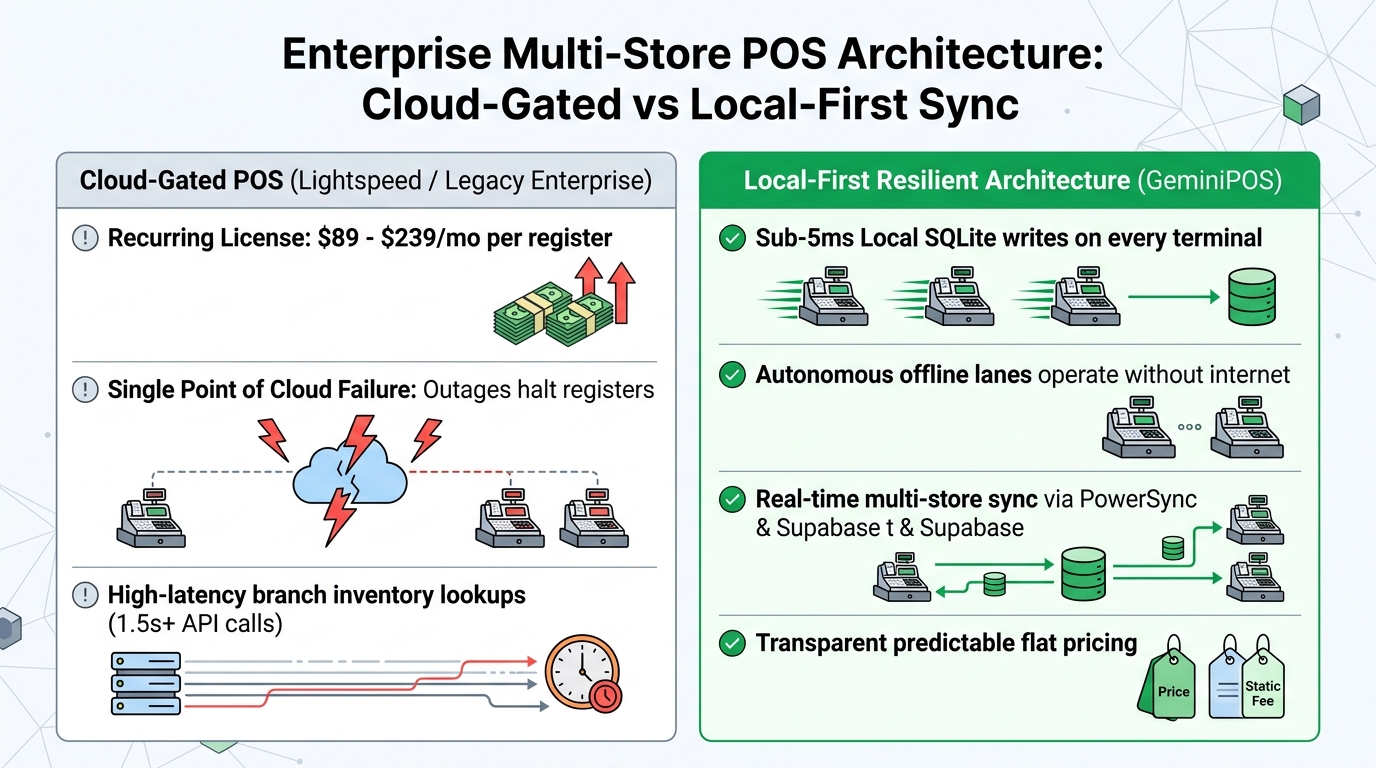
Under traditional SaaS frameworks, per-register software licensing acts as a regressive tax on retail throughput. GeminiPOS replaces per-register billing with predictable flat-tier plans:
Platform Paradigm · Starter Tier · Growth Tier (Up to 10 Devices & 2 Stores) · Pro Tier (Up to 20 Devices & 5 Stores)
Per-Register Legacy SaaS · Rarely offered · Multiplies per active register + module add-ons · Multiplies per active register + HR/accounting add-ons
GeminiPOS Flat-Tier Model · $0/mo Free Forever (1 device, 1 store, offline) · $7.34/mo ($70.48/yr) · $14.68/mo ($140.95/yr)
By decoupling licensing from individual checkout silicon, retail enterprises retain capital for expansion, inventory acquisition, and customer acquisition.
---
2. Distributed State Management: Cloud Hop vs Local SQLite
In high-volume multi-unit retail, cross-outlet inventory visibility is vital for fulfilling customer requests and preventing lost sales.
- The Cloud Hop Bottleneck: In a cloud-dependent paradigm, querying inventory at secondary locations triggers an asynchronous REST request to remote data centers.
- Local-First Distributed Sync: GeminiPOS embeds a local relational SQLite database inside each physical terminal. Synchronized via PowerSync background event streams, multi-store stock states are maintained in local storage. Cross-store queries execute as sub-millisecond local B-Tree index scans, delivering instant answers without network waits.
---
3. Comparative Architecture Matrix
Architectural Dimension · Per-Register Cloud POS · GeminiPOS Local-First
Software Licensing Model · Per-register / per-location monthly fees · Flat-tier pricing ($0 Starter, $7.34 Growth, $14.68 Pro)
Offline Fault Tolerance · Degraded / Cache limited · 100% Deterministic Local SQLite
Cross-Store Query Latency · WAN API roundtrip · Sub-second (Local Cache Sync)
Hardware Agility · Restricted hardware bundles · Any Commercial Android hardware
Database Architecture · Cloud-only multi-tenant · Distributed Local-First + Supabase
---
4. Architectural Summary
For multi-unit retailers modernizing their POS estate, transitioning from per-register SaaS models to modern local-first Android architectures provides substantial TCO reductions, zero-downtime reliability, and instantaneous cross-store inventory control.
Lightspeed vs GeminiPOS: published facts (checked 14 November 2026)
*All Lightspeed figures come from Lightspeed's own pages on the date above. Prices change; check the linked page before you buy.*
· Lightspeed (US) · GeminiPOS
Retail software · Basic $89, Core $149, Plus $289 per month, 1 register included (Lightspeed retail pricing) · Starter $0 (1 device, offline); Growth about $7.34/month (10 devices, 2 stores); Pro about $14.68/month (20 devices, 5 stores)
Restaurant software · Starter $69, Essential $189, Premium $399 per month; kitchen display $30 per screen per month (Lightspeed restaurant pricing) · Same plans; kitchen display is part of the app with no per-screen fee
Card processing · Lightspeed Payments, card-present 1.5% quoted on the retail pricing page · Your own Stripe account; Stripe's rates apply
Platforms · Retail runs on iPad, Mac and Windows · Any Android phone or tablet, or Android POS terminals
Per-item tax · Supported · One combined rate per store today; per-item tax classes in development
Gift cards · Online, with in-store listed as coming soon · Not yet
Accounting · Xero integration · Double-entry accounting, P&L and balance sheet built in
Where Lightspeed is stronger today: per-item tax, gift cards, an integrated payments product, Apple and Windows hardware, and certified fiscal compliance in some European countries.
Where GeminiPOS is different: published prices from $0, no per-register or per-screen fees, any Android device, and accounting built into the POS.