
In enterprise service-retail systems—spanning luxury automotive maintenance, high-end aesthetic clinics, multi-chair salon franchises, and bespoke tailor operations—sales incentive attribution represents an algorithmic challenge.
When incentive models rely on post-hoc batch processing across detached spreadsheets, three failure modes manifest: attribution collision, margin inversion, and statutory reconciliation drift.
This architectural paper details the design of the GeminiPOS Algorithmic Commission Evaluation Engine, analyzing its multi-agent split-attribution model, dynamic thresholding math, and immutable ledger integration.
---
1. Mathematical Formulation: Multi-Tier Dynamic Split Attribution
In modern service environments, an invoice item $I_k$ with gross sales price $P_k$ and underlying cost of goods $C_k$ cannot be modeled as a scalar employee credit. It must be computed as an attributed payout vector $\vec{\Omega}_k$:
$$\vec{\Omega}_k = \sum_{j=1}^{m} \omega_{k,j} \cdot \Phi\left(P_k, C_k, \text{Tier}_j, \text{Role}_j\right)$$
Subject to the conservation constraint:
$$\sum_{j=1}^{m} \omega_{k,j} = 1.0, \quad 0 \le \omega_{k,j} \le 1.0$$
Where:
- $\omega_{k,j}$ represents the fractional contribution weight assigned to employee $j$.
- $\Phi(\dots)$ denotes the evaluation kernel taking into account margin floors:
$$\Phi = \max\left(0, \min\left(P_k - C_k, P_k \times R_{\text{role}} \times \psi(\text{CumulativeMTD})\right)\right)$$
Here, $\psi(\text{CumulativeMTD})$ is the step function governing quota thresholds:
$$\psi(S) = \begin{cases}
1.00 & \text{if } S < T_1 \\
1.25 & \text{if } T_1 \le S < T_2 \\
1.60 & \text{if } S \ge T_2
\end{cases}$$
This mathematical construct guarantees that commission payouts can never exceed item gross margins regardless of stacked incentive bonuses.
---
2. Event-Driven Transaction Pipeline
!Enterprise Technical Architecture of Algorithmic Service Commission Engine and Payroll Sync
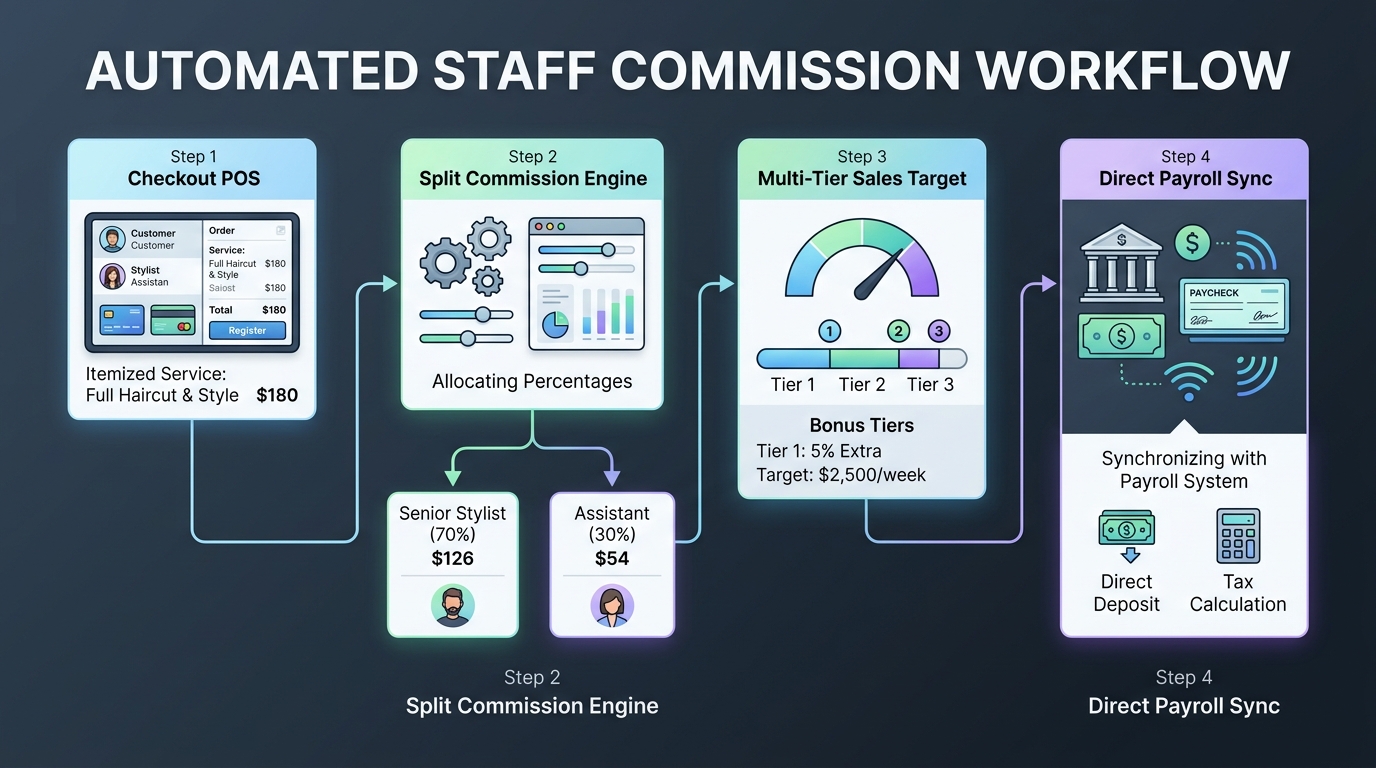
The commission engine is executed within an atomic database transaction boundary during point-of-sale checkout commit:
Immutable Ledger Characteristics
- Idempotency: Re-processing a finalized sale event produces identical attribution journal entries via deterministic transaction hashes.
- Void / Refund Reversals: If a supervisor processes a refund or partial chargeback, compensating entries are automatically appended to the employee's pending balance, preventing unearned bonus payouts.
- Role-Based Isolation: Row-Level Security (RLS) guarantees that individual staff can inspect only their personal attributed journal entries, preventing organizational leakage of peer compensations.
---
3. Statutory Compliance and Ledger Partitioning
In localized multi-tenant environments, calculating gross commission is merely the preamble. The engine must interface directly with regional tax and statutory deduction pipelines:
$$\text{NetPayout}_j = \text{BaseSalary}_j + \sum \Omega_j - \sum \text{StatutoryDeductions}(\text{GrossEarnings}_j)$$
By computing commissions inside the core transactional datastore rather than downstream third-party silos:
- Shifts, overtime (OT), and commissions are consolidated into a unified payroll state machine.
- Statutory withholding schedules (e.g., Malaysia EPF, SOCSO, EIS, and Monthly Tax Deductions) are derived dynamically from aggregate earnings.
---
4. Architectural Comparison
Metric · Batch Scripting / Spreadsheets · GeminiPOS Commission Architecture
Execution Latency · $T + 30\text{ days}$ batch delay · $< 150\text{ ms}$ synchronous at POS commit
Split Attribution Math · Linear manual ratios · Multi-resource fractional weight kernel
Margin Safety · Vulnerable to selling below cost · Hard algorithmic ceiling ($P_k - C_k$)
Audit Provenance · Unversioned cell edits · Cryptographically chained ledger journal
Auditability · Weak; prone to dispute · Immutable transaction-bound attribution
---
5. Architectural Recommendations
- Enforce Fractional Normalization at Checkout: Ensure the POS user interface strictly requires attribution weights to sum to exactly $100\%$ before unlocking the payment gateway.
- Partition Historical Attribution Ledgers: For multi-unit franchises processing millions of line items annually, partition attribution tables by monthly billing windows to preserve query velocity.
- Decouple Quota Evaluation from Real-Time Path: Calculate month-to-date tiered jumps via an asynchronously updated Redis cache to maintain sub-second checkout speeds.
---
6. Conclusion
Modern service commerce demands mathematical precision at the intersection of sales attribution and compensation. By implementing an algorithmic commission engine bounded by margin ceilings and integrated with statutory ledgers, retail enterprises eliminate operational friction and align employee incentives with sustainable business profitability.
> Designing high-throughput service POS and commission architectures?
> Explore the GeminiPOS engineering paradigm and distributed ledgers.
> Read the Architecture Documentation or Connect with Our Systems Architects.