
In enterprise service-commerce architectures—spanning multi-bay automotive service franchises, high-end medical aesthetic clinics, and complex technical repair networks—the transactional boundary extends far beyond scanning barcoded products.
Service POS systems must resolve a multi-dimensional constraint satisfaction problem: coordinating finite practitioner competencies, physical bay constraints, asynchronous parts allocation, and dynamic labor billing.
This engineering paper examines the architecture of the GeminiPOS Service & Work Order Engine, analyzing its bipartite graph reservation model, work order state transitions, and atomic invoice checkout commits.
---
1. Mathematical Formulation: Multi-Resource Bipartite Scheduling
A service booking event $B_k$ cannot be treated as a simple scalar calendar block. It must satisfy a bipartite graph constraint across heterogeneous resource domains:
$$B_k = \left( t_{\text{start}}, t_{\text{end}}, T_i, S_j, E_m \right)$$
Where:
- $T_i \in \mathcal{T}$ represents an accredited technician possessing required competency certs $\mathcal{C}(T_i) \supseteq \text{ReqCerts}(S_j)$.
- $S_j \in \mathcal{S}$ represents the target physical service bay or operating theater.
- $E_m \in \mathcal{E}$ represents specialized mechanical or clinical equipment.
The scheduling engine enforces non-overlapping temporal intervals across every assigned dimension:
$$\forall B_p, B_q \in \mathcal{B}, \quad \left( B_p \cap_{\text{temporal}} B_q \neq \emptyset \right) \implies \left( T(B_p) \neq T(B_q) \land S(B_p) \neq S(B_q) \land E(B_p) \neq E(B_q) \right)$$
Violating any component of this constraint rejects the prospective reservation, guaranteeing absolute protection against multi-resource race conditions under concurrent client bookings.
---
2. Work Order Lifecycle State Machine
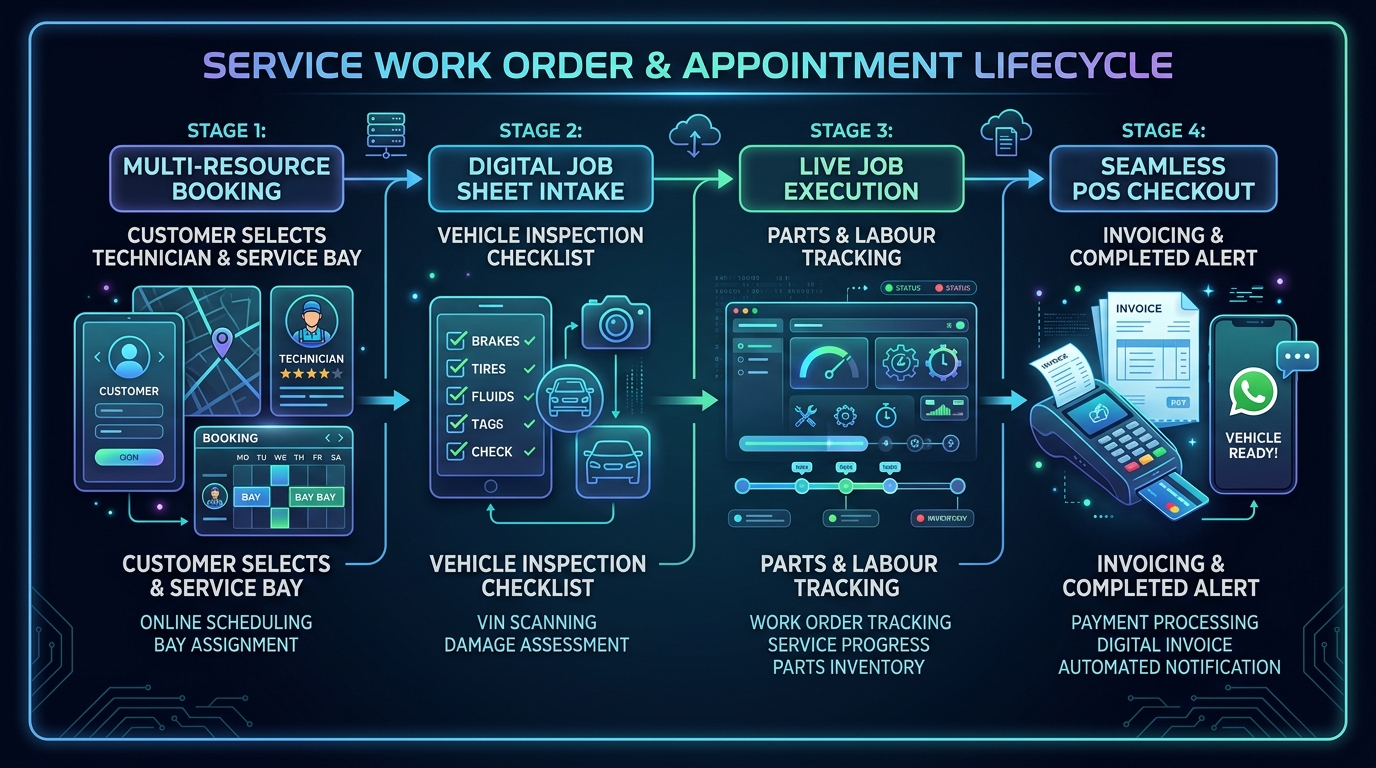
Digital Work Orders transition through an audited, multi-stage state machine:
Atomic Invariants
- Intake Integrity: Vehicle inspection data (odometer, VIN, damage photographs) must be cryptographically hashed and anchored before state advances to
JOB_IN_PROGRESS. - Dynamic Material Reservation: Parts pulled from physical inventory during service execution trigger immediate
HOLDstatuses on the central catalog ledger, preventing double-promise conflicts across online e-commerce channels. - Atomic Conversion: The transition from
QC_APPROVEDtoCHECKOUT_INVOICE_GENERATEDis atomic: parts line items and labor rate line items are bundled into a single POS checkout session with tax category segregation.
---
3. Asynchronous Customer Communication & No-Show Telemetry
Service businesses face significant operational degradation from abandoned appointments. The GeminiPOS pipeline mitigates this via an event-driven notification broker:
- Cron-Triggered Notification Queues: A resilient Redis-backed scheduler inspects reservation states at $T - 24\text{h}$ and $T - 2\text{h}$.
- Bidirectional Webhook Acknowledgments: Outbound WhatsApp/SMS interactive messages present one-touch confirmation buttons. Inbound webhook callbacks update reservation states to
CONFIRMEDor atomically release blocked resources upon cancellation.
---
4. Architectural Comparison
Capability · Disconnected Calendar + POS · GeminiPOS Unified Service Architecture
Scheduling Engine · Isolated consumer calendars (Google/Outlook) · Constraint-checked multi-resource graph
Intake Documentation · Paper inspection sheets in filing cabinets · Immutable digital media intake with VIN telemetry
Parts Allocation · Unrecorded manual parts pulling · Real-time POS catalog holds via barcode scan
Invoicing Conversion · Manual re-keying into standalone cash register · One-tap zero-loss atomic work-order checkout
Customer Retention Loop · Lost in spreadsheets · Automated recall daemons based on service intervals
---
5. Architectural Recommendations
- Decouple Dynamic Labor from Fixed Catalog SKUs: Model labor charges with dynamic hourly multipliers and technician skill modifiers rather than static catalog records.
- Enforce Pre-Service Photographic Verification: Require client signatures on photographic damage logs directly on mobile tablets before unlocking technician wrenching status.
- Index Vehicle Telemetry for Predictive Recall: Maintain an operational time-series database of vehicle mileage and service history to drive predictive maintenance push notifications.
---
6. Conclusion
Service commerce requires deep architectural synthesis between temporal resource scheduling, digital work order execution, and point-of-sale transactional settlement. By architecting an integrated, constraint-satisfying service pipeline, modern service enterprises eliminate scheduling contention, protect billable labor margins, and build lasting customer loyalty.
> Engineering next-generation service and workshop POS systems?
> Discover how GeminiPOS powers enterprise service operations and work order architectures.
> Read Technical Documentation or Consult Our Solutions Architecture Team.