
Operating an enterprise retail or hospitality network comprising hundreds of distributed physical registers presents severe structural challenges in data propagation and tenant boundary governance.
Traditional decentralized POS setups suffer from schema drift, conflicting SKU definitions, and uncontrolled margin degradation. Conversely, naive monolithic cloud setups introduce single-point-of-failure network latency that degrades lane throughput during local communication severed events.
This technical engineering paper details the system architecture of GeminiPOS's Hierarchical Multi-Unit Governance Engine, analyzing declarative master catalog propagation, regional pricing inheritance topographies, and cryptographic role-based access control (RBAC) at the edge register.
---
1. Topographical Hierarchy: From Master HQ to Edge Node
!Multi-Branch Central Master Catalog & Regional Price Tier Engine Architecture
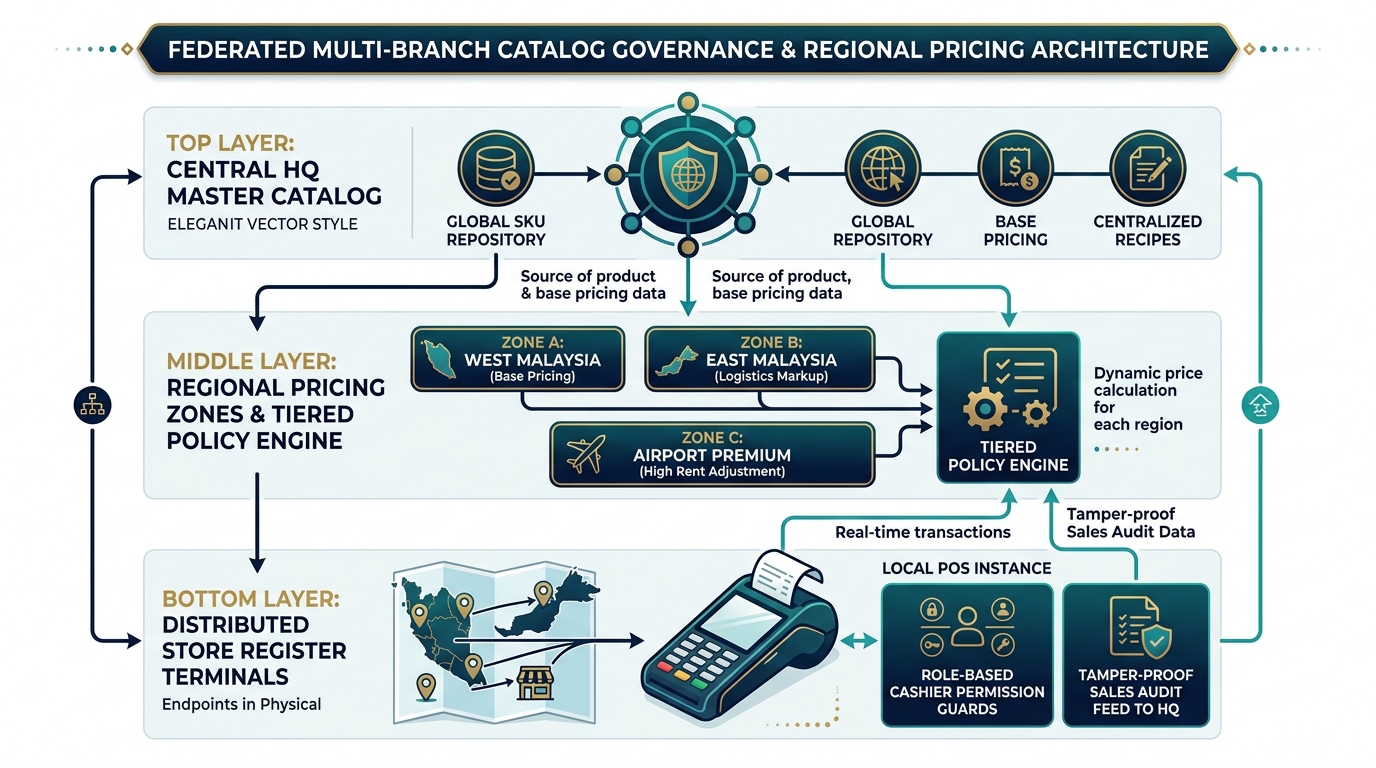
The data model establishes a directed tree structure governing catalog inheritance and operational policy:
---
2. Declarative Catalog Inheritance & Delta Propagation
Rather than maintaining isolated product tables across distinct store databases, products reside within a unified versioned relational schema:
Price Evaluation Invariant
When an Android register evaluates line item pricing during cart construction, it resolves the effective retail price through a deterministic cascade:
$$P_{\text{effective}} =
\begin{cases}
P_{\text{store}} & \text{if store override exists} \\
P_{\text{zone}} & \text{else if regional zone override exists} \\
P_{\text{base}} & \text{fallback to corporate master MSRP}
\end{cases}$$
This inheritance model ensures that modifying a national baseline price instantly updates every store in the country, while regional logistical markups (e.g., maritime shipping to East Malaysia) remain intact without maintaining duplicated SKU definitions.
---
3. Cryptographic Role-Based Access Control (RBAC) at Edge
Registers execute high-risk operations (voids, cash drawer kicks, manual discounts, tax exemptions) under strict cryptographic authorization constraints:
Every supervisory override generates an immutable event log stamped with the authorizing manager's cryptographic signature, streaming asynchronously to HQ for anti-collusion pattern detection.
---
4. Multi-Tenant Franchise Isolation Boundaries
In franchise operational topologies, multiple independent legal entities share a single master brand catalog:
- Row-Level Security (RLS) Policies: Franchisee accounts operate under rigorous multi-tenant database policies. Store owners query their local sales receipts, inventory counts, and cash drawer reconciliations, but are structurally prohibited from reading financial performance or staff records belonging to neighboring franchisees.
- HQ Royalty Aggregator: Franchisor administrators possess elevated cross-tenant analytical views, querying aggregated gross merchandise value (GMV) streams to automate contractual royalty invoicing.
---
5. Architectural Invariants Summary
Vector · Edge Constraint · HQ Constraint
Catalog Updates · Read-only cache with delta sync · Full CRUD with version epoch increment
Pricing Calculation · Deterministic 3-tier cascade (< 2ms) · Zone definition and margin rule enforcement
Audit Log Integrity · Append-only WAL in local SQLite · Immutable cold storage in PostgreSQL
Inter-Branch Stock · Dispatched via signed custody handshakes · Global inventory reconciliation pipeline
---
6. Conclusion
Building point-of-sale infrastructure capable of scaling to multi-national franchise estates requires strict separation between master catalog definitions and local operational node policies. By combining declarative catalog inheritance, zone-based pricing rules, and cryptographically verified edge RBAC, GeminiPOS provides an uncompromised enterprise management foundation.
> Engineering Enterprise Retail Platforms?
> Explore GeminiPOS's multi-unit architecture, edge synchronization protocols, and distributed RBAC.
> Explore Architectural Details or Connect with Our Architects.