
Modern commercial foodservice operates under increasingly rigorous multi-jurisdictional compliance frameworks—from FDA Food Safety Modernization Act (FSMA 204) traceability rules and European Union FIC Regulation 1169/2011 to stringent Halal, Kosher, and allergen containment protocols.
When regulatory compliance or foodborne contamination incidents occur, legacy restaurants face an operational bottleneck: critical supply chain data remains trapped in manual paper invoices, decoupled from the active POS terminals transacting orders at the counter.
This engineering paper examines the system design of an Edge-Integrated Dietary & Traceability Engine, detailing how GeminiPOS couples Goods Received Note (GRN) lot ingestion, declarative Recipe BOM allergen graphs, and tamper-evident audit telemetry directly into distributed Android POS instances.
---
1. End-to-End Ingredient Pedigree Pipeline
!Halal Supply Chain Assurance and Traceability in a POS System
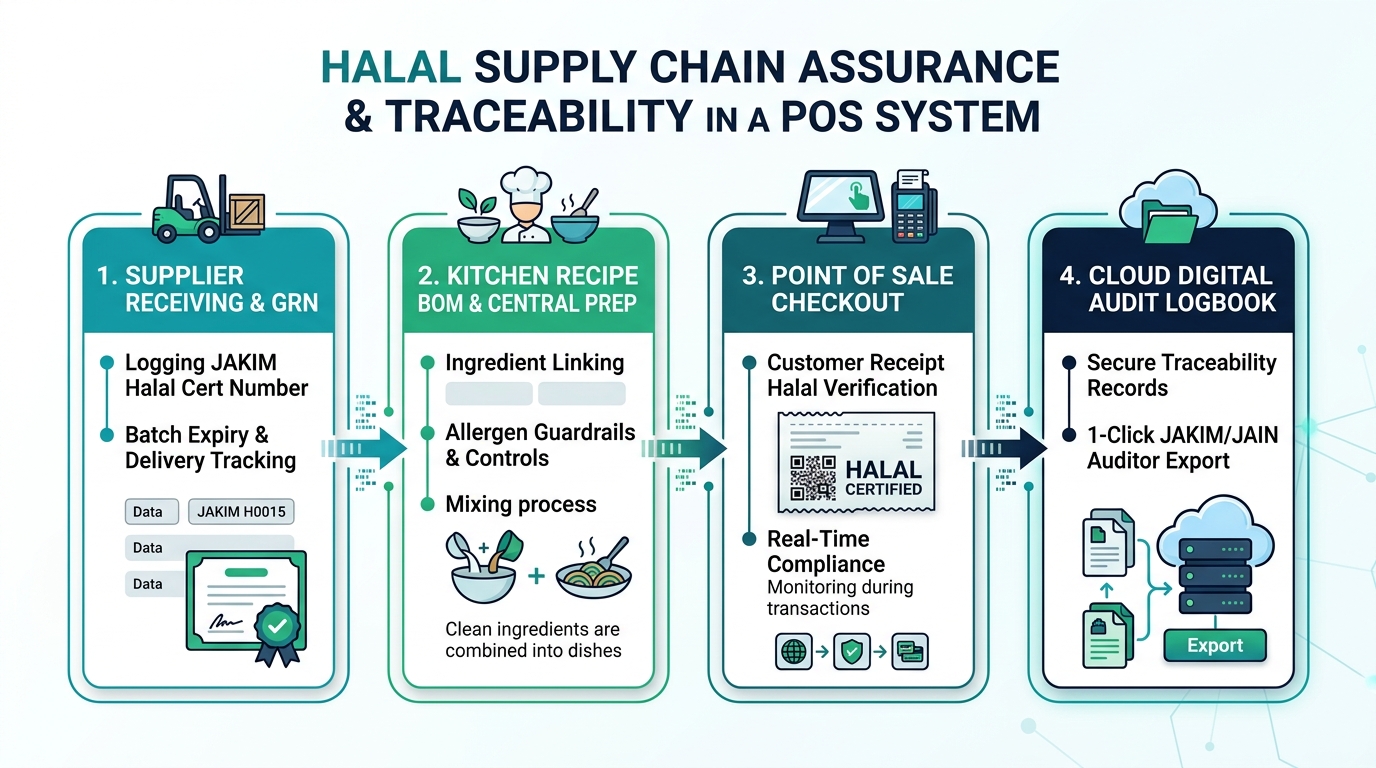
To achieve deterministic sub-second traceability across multi-unit hospitality estates, the data model unifies four discrete layers:
---
2. Inbound Lot Tracking & Certification Guardrails
At the physical receiving dock, inventory ingestion cannot remain a simple quantity counter. Inbound Goods Received Notes enforce mandatory cryptographic and metadata fields:
supplier_cert_id: National or international governing accreditation identifier (e.g., JAKIM Halal, Kosher OU, Organic USDA).cert_valid_until: High-resolution expiration timestamps.manufacturer_batch_lot: Upstream manufacturer production lot string.temperature_at_intake: Edge sensor or manual probe telemetry for cold-chain integrity.
Gate Evaluation Invariant
If cert_valid_until < NOW() or intake_temp > cold_chain_threshold, the ingest pipeline rejects the shipment at the API gateway layer, preventing uncertified raw materials from polluting the active inventory stock-pool.
---
3. Declarative Allergen & Dietary Recipe Graph
At the kitchen preparation and checkout layer, dishes are resolved via a Directed Acyclic Graph (DAG) of raw ingredients:
When a guest requests a custom substitution at the POS counter (e.g., swapping a sauce), the checkout engine evaluates the proposed DAG permutation in real time. If a substituted ingredient violates the declared dietary constraint or introduces an undeclared allergen, the checkout terminal triggers a modal override refusal requiring managerial authorization.
---
4. High-Throughput Audit Telemetry & Regulatory Inspections
Traditional food safety audits consume dozens of managerial hours cross-referencing physical receipts. GeminiPOS structures every transaction with immutable lineage metadata:
- Transaction Item Stamping: Each line item sold records an exact snapshot of the active ingredient lots consumed at the moment of sale.
- Reverse Traceability Indexing: If a national health authority issues a recall for *Lot #B4920-X*, a single query identifies every customer order, branch register, and time-window affected within milliseconds.
- Air-Gapped Offline Durability: Because registers operate on an offline-first SQLite core powered by PowerSync, receiving checks and kitchen BOM validations continue uninterrupted even during internet outages.
---
5. Architectural Summary
Layer · Functional Responsibility · Latency Budget
Dock Intake (GRN) · Validates certificates, logs batch lots, enforces cold chain · < 50ms per item
Edge BOM Engine · Maps recipe DAGs, evaluates allergen invariants · < 10ms at cart mutate
Counter Register · Displays dietary tags, enforces substitution rules · Real-time UI thread
HQ Compliance Hub · Aggregates multi-unit audit logs, generates regulatory exports · Asynchronous background
---
6. Conclusion
Embedding supply chain traceability directly into the point of sale bridges the critical gap between backend warehouse management and customer-facing operations. By validating raw material pedigree at dock receiving and continuously enforcing recipe invariants, distributed hospitality brands eliminate compliance blind spots while protecting consumer safety.
> Engineering Enterprise Hospitality Systems?
> Discover how GeminiPOS architecturally unifies inventory traceability, POS checkout, and regulatory compliance across distributed retail estates.
> Explore Architectural Capabilities or Connect with Our Technical Team.