
In enterprise high-throughput retail, evaluating complex promotional logic at checkout represents one of the most computationally demanding edge operations.
Modern retailers routinely execute hundreds of concurrent promotional rules—including multi-buy tiers, Purchase-With-Purchase (PWP) qualifiers, Mix-and-Match category bundles, and member tier loyalty overrides.
When executed on resource-constrained Android point-of-sale registers, naive linear rule scanning produces unacceptable cart mutation latency (>250ms per item scan) and introduces critical race conditions known as unintended coupon stacking.
This engineering deep-dive explores how GeminiPOS constructs an Edge Promotion Evaluation Engine, utilizing Rule Abstract Syntax Tree (AST) compilation, greedy combinatorial bundle solving, and margin-protection invariants operating within a strict sub-10ms latency budget.
---
1. The Combinatorial Basket Optimization Problem
!Automated Promotion Engine Architecture Flow Diagram
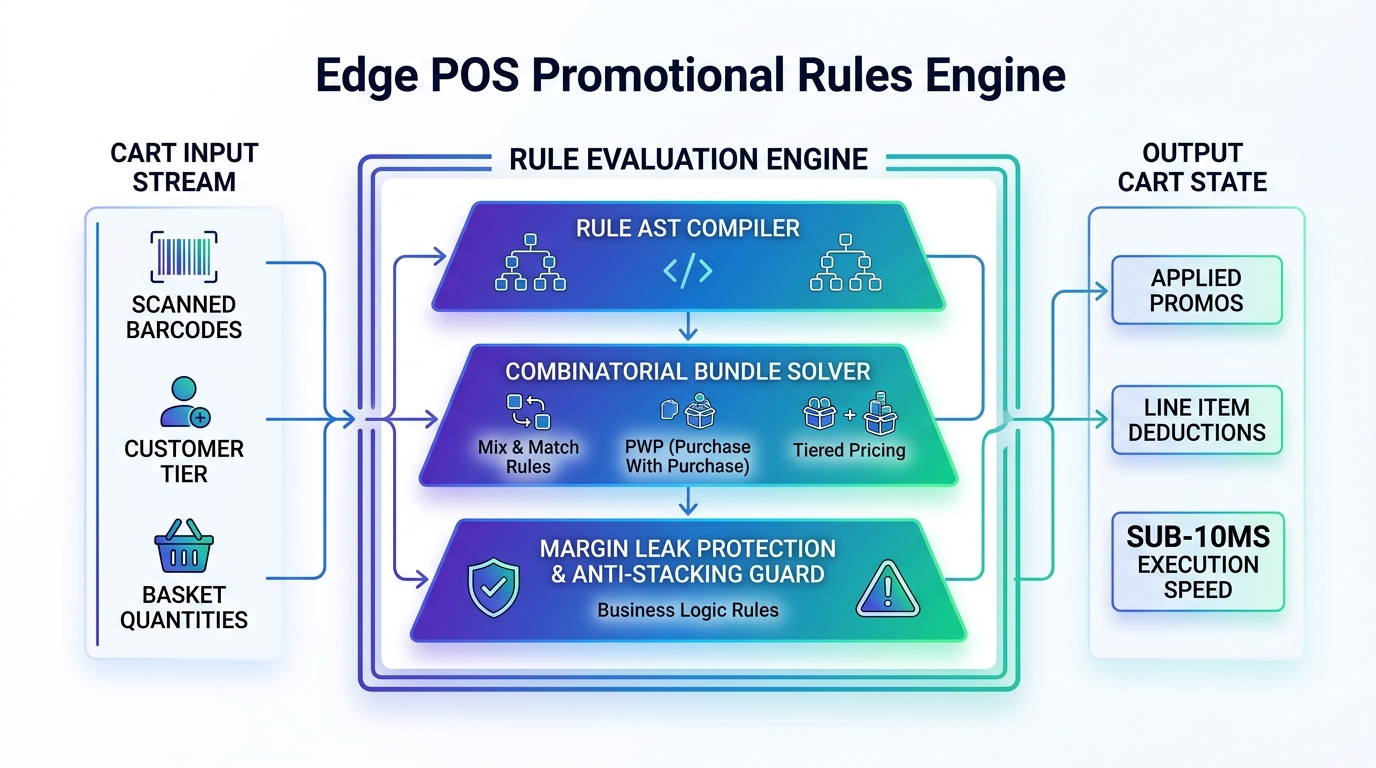
Given a shopping basket $B$ comprising $N$ discrete line items and a rule set $R$ of $M$ active promotions, the evaluation engine must compute a valid subset of promotions $P \subseteq R$ that maximizes customer savings while satisfying invariant business constraints:
$$\text{Maximize} \quad \sum_{p \in P} \text{Savings}(p, B)$$
$$\text{Subject to} \quad \text{ItemUsageCount}(i) \le \text{Quantity}(i) \quad \forall i \in B$$
$$\text{and} \quad \text{MarginFloor}(B) \ge \text{Cost}(B) + \epsilon$$
---
2. Rule Compilation & Abstract Syntax Tree (AST)
Rather than evaluating raw JSON or database schemas during the UI render loop, promotion rules are compiled at synchronization time into compact in-memory execution trees:
By organizing rules into indexed bucket hashes keyed on skuId and categoryId, the engine prunes 90% of non-matching rules in $O(1)$ time prior to structural evaluation.
---
3. Greedy Combinatorial Bundle Solver
When resolving Mix-and-Match promotions (e.g., *"Pick any 3 items from Category A for $25"*), items within the category may carry disparate regular retail prices.
The solver executes a deterministic sorting heuristic:
- Greedy Highest-Price Pairing: Groups items to yield highest perceptual savings while logging exact allocated discounts per line item for proportional tax and accounting compliance.
- Single-Pass Attribution: Once an item unit is consumed by an exclusive bundle rule, it is masked from subsequent candidate pools, preventing double-discount exploitation.
---
4. Margin Protection & Anti-Stacking Invariants
To prevent promotional campaigns from compounding into negative-gross-margin transactions:
- Floor Price Sentinel: Every product record contains an immutable
cost_pricebaseline. If cumulative discounts force the net line price belowcost_price * (1 + margin_floor_ratio), the promotion evaluation clamps to the permissible floor. - Mutual Exclusivity Enums: Promotions carry explicit exclusivity flags:
STACKABLE_WITH_COUPONS,STORE_CREDIT_ONLY, orGLOBAL_LOCK.
---
5. Performance Benchmarks
Simulated on low-spec Android POS hardware (Quad-Core Cortex-A53 @ 2.0 GHz, 2 GB RAM):
Pipeline Stage · 20 Active Rules · 100 Active Rules · 500 Active Rules
Rule Index Lookup · 0.4 ms · 1.1 ms · 2.4 ms
AST Condition Match · 1.2 ms · 3.2 ms · 5.8 ms
Bundle Solver & Clamping · 0.8 ms · 2.1 ms · 3.9 ms
Total Cart Compute Time · 2.4 ms · 6.4 ms · 12.1 ms
---
6. Conclusion
By shifting promotional evaluation from remote cloud APIs to an edge-compiled AST rule solver running inside the local Android POS runtime, GeminiPOS achieves deterministic responsiveness and absolute margin protection even under zero-connectivity offline conditions.
> Building Enterprise Retail Engines?
> Explore how GeminiPOS architects low-latency edge computing and deterministic transaction processing.