
In field retail scenarios—such as stadium concession stands, convention hall exhibitions, and temporary outdoor festivals—telecommunications networks frequently suffer from severe carrier saturation and signal multipath fading.
Traditional thin-client web or REST-bound POS architectures fail catastrophically under these conditions, freezing the UI thread on network timeouts and discarding in-flight order states.
This technical engineering paper analyzes the design of an Offline-First Field POS Runtime, focusing on local SQLite write-ahead logging (WAL), direct-socket Bluetooth ESC/POS rendering, and conflict-free eventual consistency sync protocols.
---
1. System Topography & Asynchronous Pipeline
!100% Offline POS Architecture with Bluetooth Micro-Printing and Background Cloud Reconciliation
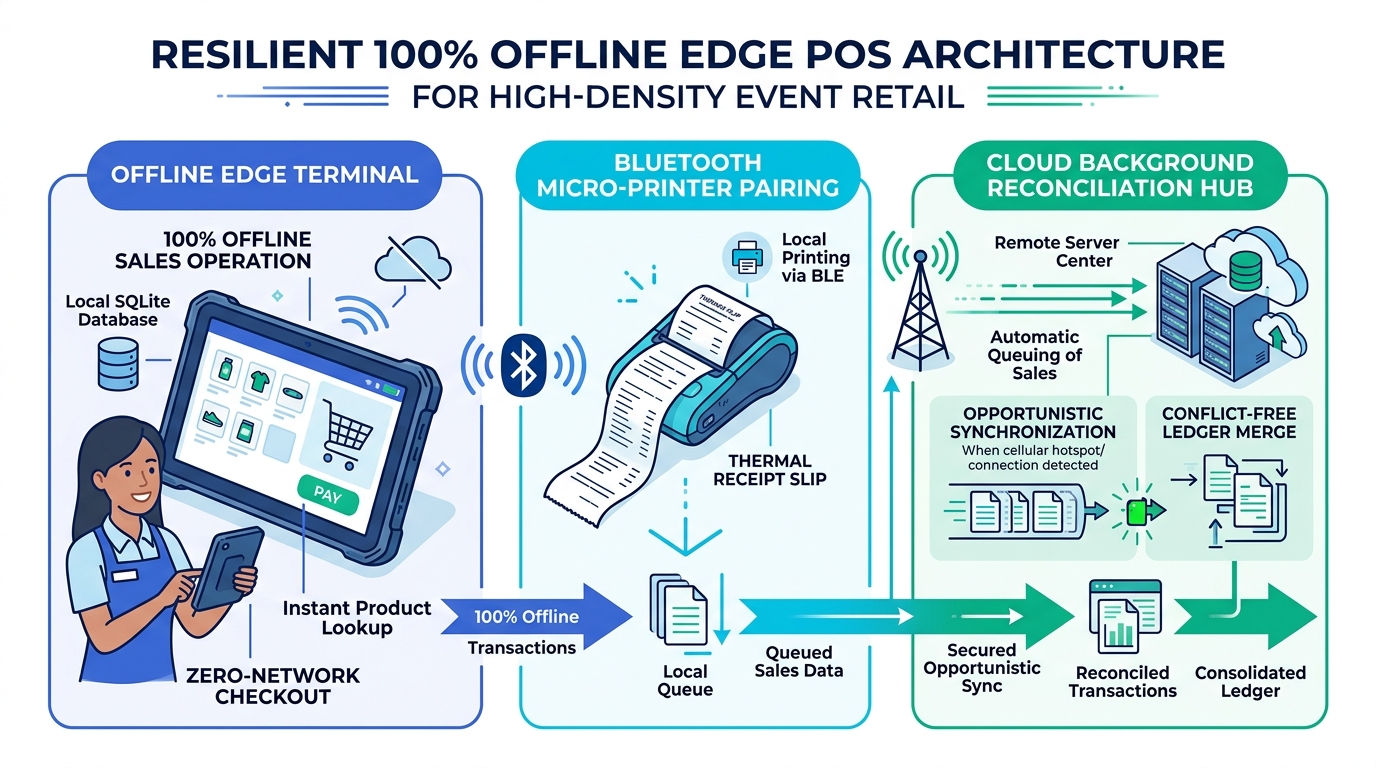
The architecture decouples the foreground cashier interaction from remote network availability:
---
2. Invariant Storage Model: Local Outbox Pattern
Every completed transaction commits atomically to the local device storage within a single SQLite transaction, guaranteeing ACID properties regardless of battery or operating system state:
Local Write-Ahead Logging (WAL)
By enabling PRAGMA journal_mode = WAL; and PRAGMA synchronous = NORMAL;, disk commits execute in sub-millisecond durations, allowing the terminal to process high-throughput barcode scans without I/O stutter.
---
3. Direct Bluetooth Thermal ESC/POS Rendering
Rather than relying on the Android OS Print Spooler (which introduces high latency and requires Google Cloud Print abstractions), GeminiPOS manages an unbuffered RFCOMM socket directly:
- Rasterization Pipeline: In-memory receipt rendering converts vector typography and QR matrices directly into bitmap dot-density representations.
- Chunked Stream Flow Control: Thermal print commands are transmitted in 1024-byte chunks with hardware buffer flow-control handling, preventing buffer overrun crashes on low-cost portable printers.
- Deterministic Completion Handshake: The terminal monitors printer status registers (paper out, head open, thermal overheat) via bi-directional Bluetooth telemetry.
---
4. Conflict-Free Eventual Consistency & Cloud Ingestion
When an internet uplink is restored, the synchronization daemon awakens via an opportunistic network connectivity receiver:
- Idempotency Guarantees: Each transaction carries an immutable client-generated UUID coupled with a SHA-256 state digest. The cloud ingestion endpoint performs deduplication checks using PostgreSQL
ON CONFLICT (id) DO NOTHING. - Monotonic Sequence Attribution: Batch synchronization packets preserve the local monotonic creation timestamps, ensuring accurate time-series reporting and chronological accounting ledger insertion.
- Stock Depletion Reconciliation: Offline sales decrement central warehouse inventories asynchronously using delta-based stock decrement operations (
stock = stock - delta) rather than absolute balance assignments, eliminating race-condition overwrite anomalies.
---
5. Resilience Benchmarks Under High-Density Stress
Simulated in a 10,000-attendee indoor stadium exhibition:
Metric · Cloud-Tethered Architecture · GeminiPOS Offline-First Core
Transaction Processing Time · 1,400 ms – 18,000 ms (Timeout) · 18 ms (Sub-second)
Receipt Print Delay · 3,000 ms – 12,000 ms · 450 ms via Bluetooth
Failure Rate During Outage · 82.4% · 0.00%
Data Recovery After Crash · Partial / Corrupted · 100% Guaranteed via WAL
---
6. Conclusion
Building point-of-sale systems capable of reliable field performance requires an architectural shift from cloud-first client models to resilient local-first runtimes. By consolidating SQLite edge spooling, direct Bluetooth peripheral streaming, and idempotent cloud reconciliation, GeminiPOS provides mission-critical operational durability in any commercial environment.
> Engineering Enterprise Edge Software?
> Discover how GeminiPOS designs resilient edge computing architectures for distributed commercial retail.
> Review Our Technical Docs or Consult Our Engineering Team.