
In enterprise retail and hospitality loss prevention, operator scrutiny has historically centered on physical cash variance—the daily reconciliation of tender drawers against batch closure totals.
Yet global asset protection analytics demonstrate that over 60% of internal shrinkage occurs with zero register cash variance.
How does substantial margin erosion materialize when register drawers reconcile perfectly at the close of every shift?
The root cause is unmonitored point-of-sale transactional manipulation: cashier sweethearting, unverified post-tender order voids, phantom price overrides, and unauthorized employee discount concessions.
---
1. Deconstructing Register-Level Internal Fraud
Without deterministic access governance and real-time exception logging, cashiers exploit several fundamental systemic vulnerabilities:
- Cashier Sweethearting (Accomplice Theft):
Cashiers simulate optical barcode scanning on high-margin apparel or electronics, deliberately passing items across inactive scan fields or obscuring symbologies. Accomplices exit store premises with unpaid assets.
- Post-Tender Order Annulment (Phantom Voids):
Shoppers settle transactions in exact cash and decline printed receipts. Following patron departure, the cashier annuls the entire ticket via an unmonitored order void, pockets the tendered currency, and preserves register balance alignment.
- Discretionary Discount Hijacking:
Applying unapproved 40% promotional concessions to standard transactions, charging the patron gross retail price, and siphoning the calculated cash spread.
- Arbitrary Price Alteration:
Manually overriding catalog SKU values at the terminal line item level, transferring enterprise margin to unauthorized recipients.
- Repetitive "No-Sale" Actuations:
Triggering solenoid drawer releases outside active transactional lifecycles to mask physical float skimming.
---
2. GeminiPOS Multi-Tiered Loss Prevention Architecture
GeminiPOS embeds rigorous internal controls directly into the point-of-sale transactional lifecycle:
!POS Security, Cashier Fraud Prevention, and Audit Trails Diagram
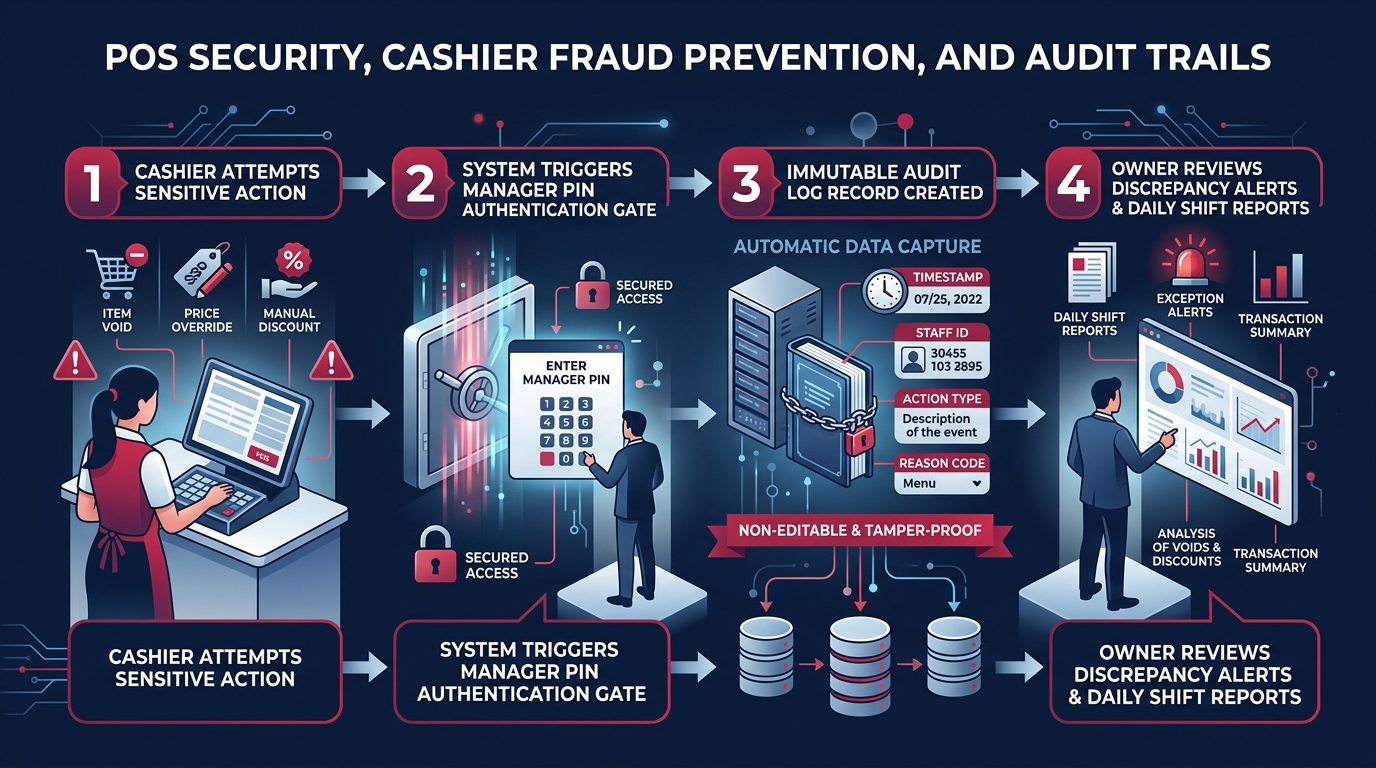
Stage 1: Exception Event Intercept
Whenever a front-of-house cashier initiates an operational exception—including line item voids, ticket annulments, manual price overrides, or discretionary markdown percentages:
- The register interface enters an immediate modal lock state.
Stage 2: Dual-Control Manager PIN Verification
The transaction cannot proceed without supervisor verification. An authorized Store Manager or Shift Supervisor must authenticate the exception using an encrypted individual PIN. Cashiers are cryptographically barred from self-approving exceptions.
Stage 3: Immutable Telemetry Logging
Every exception creates a structured, tamper-resistant audit event:
- Synchronized millisecond timestamp.
- Originating operator UUID coupled with approving manager UUID.
- Enforced reason taxonomy (e.g., *Patron Reversal*, *Damaged Stock*, *Operator Input Error*).
- Dispatched directly to the Supabase cloud backend, ensuring records cannot be scrubbed from local terminal hardware.
Stage 4: Algorithmic Exception Telemetry
Enterprise administrators monitor exception distributions programmatically:
- Flag operators whose void-to-sale ratios deviate beyond two standard deviations from the store median.
- Identify persistent manual discounting anomalies across multi-store estates.
---
3. Customer-Facing Displays (CFD): Visual Deterrence Engineering
Hardware ergonomics represent a vital component of loss prevention strategy:
- Integrated secondary Customer-Facing Displays (CFD) project line items, item pricing, and applied discounts directly into the consumer visual field.
- Faked scans and sweethearting maneuvers become nearly impossible to execute when both the paying customer and surrounding queue patrons maintain direct visual verification of the register state.
---
4. Architectural Summary & Next Steps
Deploying role-based register access controls and immutable audit logging protects enterprise gross margin, enforces operational transparency, and shields honest front-line associates from unwarranted scrutiny.
> Fortify your store network against transactional shrinkage.
> Discover how GeminiPOS delivers enterprise-grade loss prevention controls.
> Contact our Asset Protection Team or explore our Enterprise Architecture.