
In enterprise retail and hospitality, hardware refresh cycles generate colossal volumes of electronic waste while imposing massive upfront capital expenditure on emerging franchise operators.
Every year, hundreds of millions of high-performance consumer smartphones and tablets are discarded simply due to consumer upgrade cadences, despite boasting octa-core processing architectures and multi-gigabyte memory capacities that drastically outperform legacy point-of-sale registers.
Modern circular economy software engineering transforms decommissioned consumer hardware into Industrial-Grade Edge Retail Nodes.
---
1. Technical Architecture: Circular Edge Device Topology
!Repurposed Hardware POS Topology Flowchart
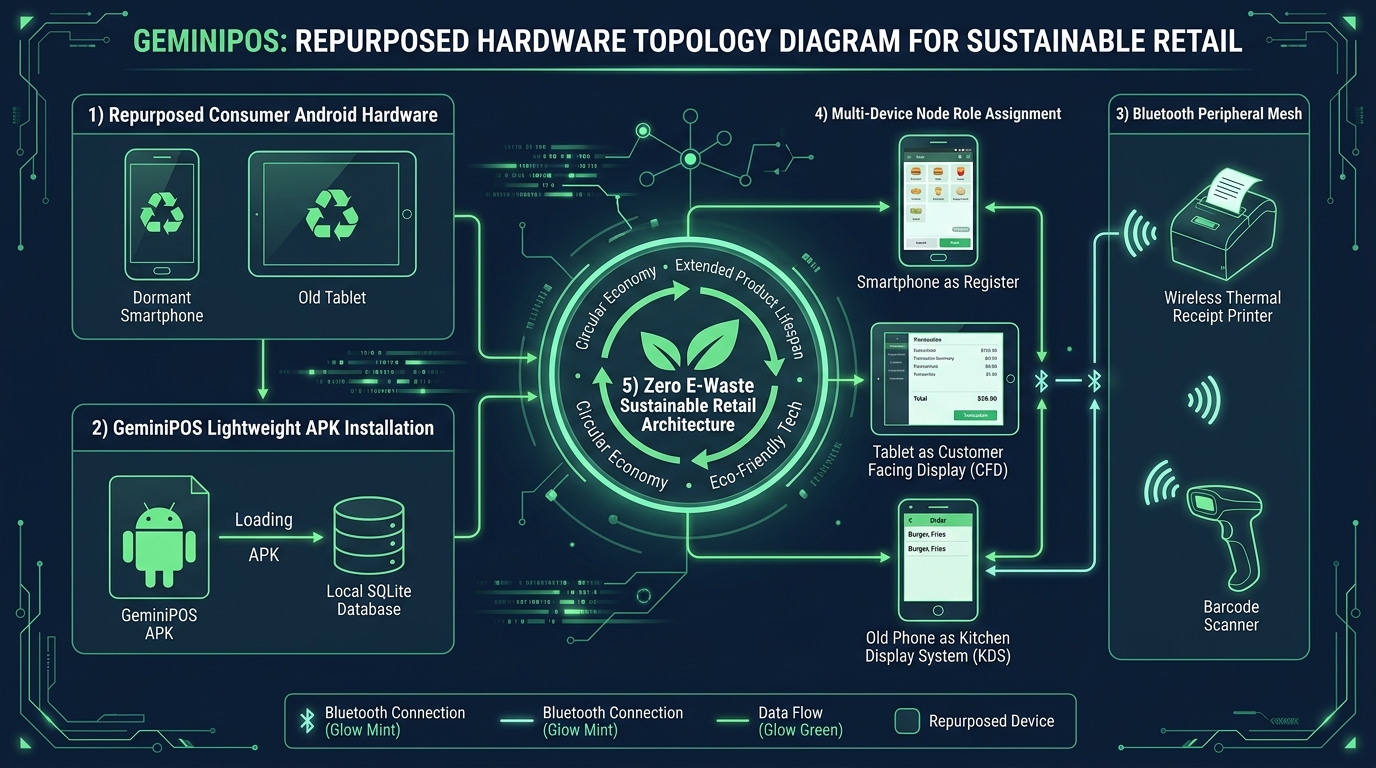
A decoupled local-first POS architecture abstracts functional retail roles across commodity consumer endpoints:
- Primary Register Node (Consumer Smartphone):
Lightweight Android native runtimes execute directly on devices running Android 8.0 through Android 15. The device's integrated camera sensor acts as an ultra-fast CMOS barcode imager via computer vision algorithms.
- Low-Energy Bluetooth Peripheral Fabric:
Decoupled peripheral management communicates asynchronously with 58mm/80mm ESC/POS thermal printers and payment acceptance terminals over Bluetooth LE without proprietary dongles.
- Customer-Facing Display (CFD Node):
Secondary dormant tablets act as interactive digital receipt and payment presentation screens over local peer-to-peer Wi-Fi networks.
- Kitchen Order Display (KDS Node):
Wall-mounted consumer smartphones act as real-time line-cook displays, receiving order payloads via local event buses and eradicating physical paper print waste.
- Circular Economy Metrics:
Extending the operational lifespan of existing consumer glass by 36 to 48 months drastically slashes Scope 3 embodied carbon footprints for multi-unit retail brands.
---
2. Engineering Considerations for Legacy Edge Hardware
- Thermal Throttling & Battery Longevity: Mitigate continuous charging degradation by leveraging Android's native 80% charge-limiting battery protection APIs or incorporating edge micro-switched USB charging circuits.
- Memory Footprint Optimization: By utilizing pure Kotlin binaries coupled with embedded SQLite engines, runtime memory is capped below 150MB, guaranteeing zero frame-drops on 2GB RAM legacy devices.
- Zero Cloud Dependence: Transaction execution operates strictly on local edge storage, insulating stores from broadband latency and network outages.
---
3. High-Efficiency Enterprise Deployment with GeminiPOS
GeminiPOS delivers an open platform designed for sustainable retail hardware:
- Native compatibility across the Android hardware spectrum.
- Zero per-device licensing toll-gates or recurring hardware activation penalties.
- Peer-to-peer local network synchronization between registers, customer displays, and kitchen nodes.
Deploy zero-waste, capital-efficient retail systems with GeminiPOS today!