Over the past decade, cloud-hosted SaaS point-of-sale architectures promised multi-store retailers liberation from legacy on-premise servers. For many merchants, that came with a new consideration: ongoing per-location subscription costs that scale with every register and store you add.
Two names come up often in this conversation: Vend, which is now branded Lightspeed Retail (X-Series) after being folded into Lightspeed (lightspeedhq.com/vend/), and Revel Systems, which is now part of Shift4 (shift4.com/food-beverage, as of October 2026). Lightspeed Retail's published plans run $89–$289/month per location, each including one register, with additional registers priced as add-ons that aren't listed publicly. Revel/Shift4 no longer publishes self-serve pricing at all — its restaurant page routes every inquiry to a sales quote request.
In 2026, some multi-store retailers are comparing these per-location, sales-quote-driven models against open, local-first Android architectures like GeminiPOS.
---
1. Architectural Comparison: Cloud SaaS vs Local-First Edge
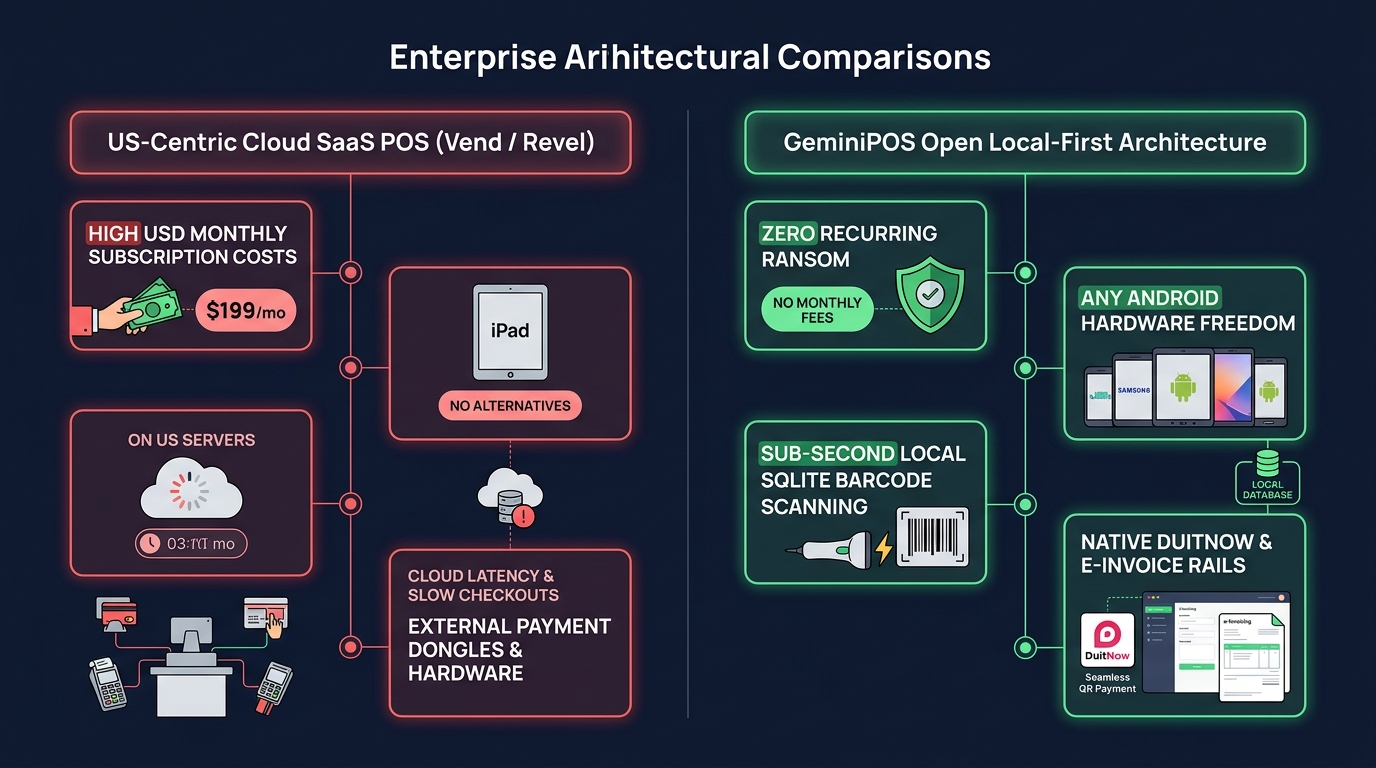
!Enterprise Architectural Comparison Flowchart
Architectural Dimension · Lightspeed Retail (formerly Vend) / Revel (now Shift4) · Open Local-First Edge (GeminiPOS)
Licensing Topology · Lightspeed: published $89–$289/mo per location, 1 register included, extra registers by quote. Revel/Shift4: pricing by quote only, not published. · Free Starter plan; paid Growth and Pro plans at a flat monthly price (see geminipos.tech/pricing)
Hardware Coupling · Lightspeed's retail hardware materials center on Apple iPad hardware; Revel/Shift4 doesn't publish current hardware requirements · Hardware-agnostic Android devices
Catalog Query Latency · Not published by either vendor for their current platforms · Local SQLite lookups on-device
Offline Transaction Resilience · Lightspeed lists an "Offline mode" feature on Restaurant plans without detail; not stated on its Retail pricing page. Revel/Shift4 doesn't publish offline details. · Full local-first offline transactions & sync queuing
Payment Rail Modularity · Lightspeed offers its own integrated payments (1.5% card-present rate); bring-your-own-processor terms aren't published · Pluggable local payment APIs (QR, EMV, Wallets)
Published Multi-Lane Pricing · Lightspeed: quote required beyond base plan + register add-ons. Revel/Shift4: quote required for everything. · Transparent flat-rate published pricing from $0
---
2. What to Check Before Committing to a Per-Location SaaS Model
- The Per-Register Add-On Cost:
Opening additional seasonal registers or deploying pop-up checkout lines on Lightspeed's Retail plans means contacting sales for add-on pricing, since that figure isn't published — budget for it before you commit to expansion.
- Hardware Refresh Planning:
Tablet hardware generally has a multi-year useful life before OS updates or component wear prompt replacement; ask any iPad-centric vendor about its hardware refresh and trade-in policies.
- Offline and Latency Behavior:
Relying on remote cloud lookups for promotional calculations or stock checks can introduce visible delays if your connection is unstable during peak hours — ask any cloud POS vendor exactly which functions work offline on your specific plan, since this is often not detailed on public pricing pages.
---
3. The Local-First Android Paradigm with GeminiPOS
By leveraging Android's open peripheral ecosystem, a lightweight embedded database, and background synchronization, GeminiPOS provides:
- Open Hardware Choice: Deploy on commercial Android touchscreens (iMin, Sunmi) or standard commercial tablets, rather than being limited to one hardware family.
- Local-First Offline Performance: Barcode scanning and receipt printing continue to work during internet outages, with sales syncing automatically once connectivity returns.
- Transparent, Published Pricing: A free Starter plan plus Growth and Pro tiers priced per month, with no register-count quote required (geminipos.tech/pricing).
Explore GeminiPOS for your multi-store retail business.