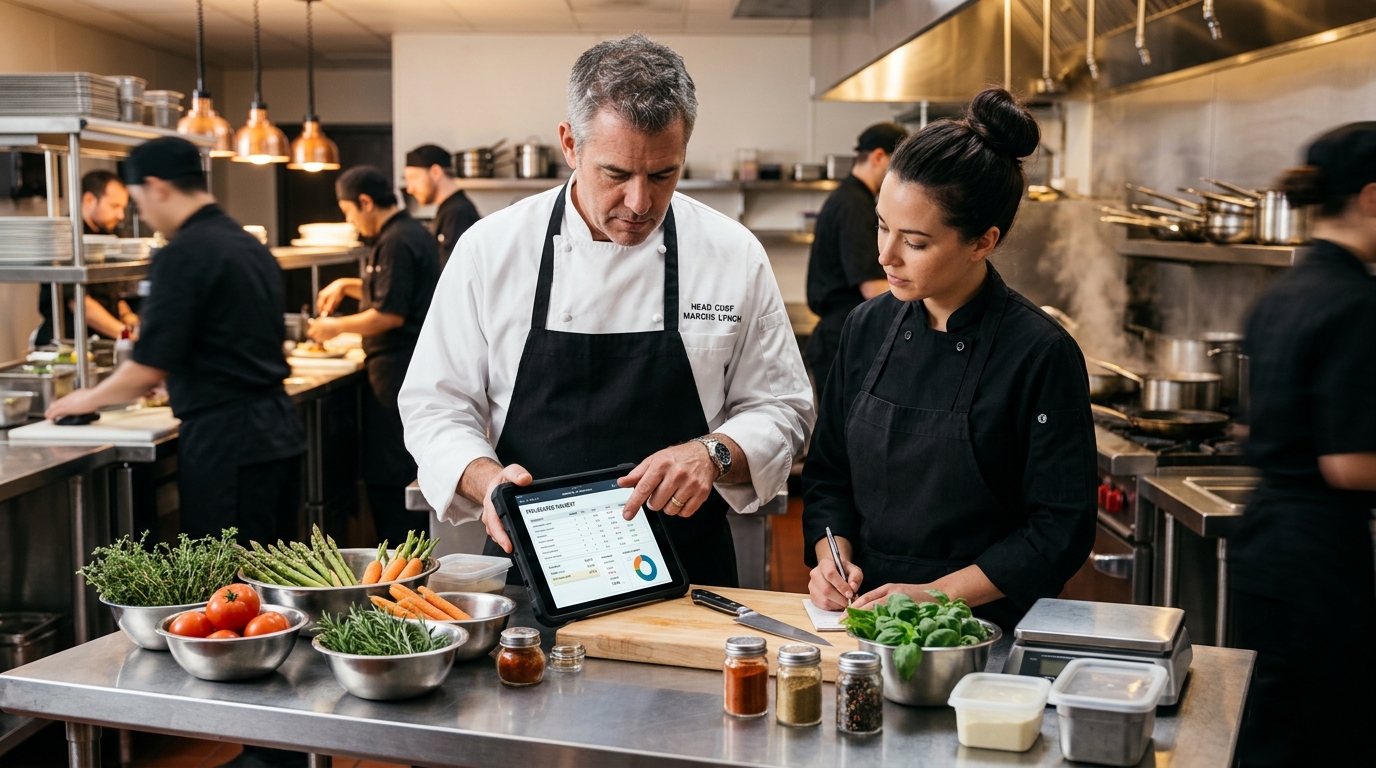
Have you ever experienced an F&B month where your cafe or bistro generated record-breaking top-line revenue, yet when corporate accounts were reconciled at month-end, the net operating profit was shockingly thin?
Across the hospitality industry, over 60% of independent restaurant failures are not caused by poor recipes or lack of foot traffic—they stem from unmonitored food cost variance and kitchen ingredient leakage.
In a busy commercial kitchen, profitability bleeds invisibly across three key fault lines:
- **Portion Creep (*Over-portioning*):** Line cooks ladle 220 grams of imported beef into a stir-fry when the standardized spec sheet prescribes 160 grams. Across 1,000 monthly covers, that 60-gram excess vaporizes thousands of ringgit.
- Disconnected Raw Goods Tracking: Operators track outbound finished plates (*"We sold 85 Grilled Chicken Bowls today"*), but maintain zero visibility over remaining bulk chicken breast, marinade sauce, and basmati rice in the cold storage walk-in.
- Shrinkage, Spoilage, and Waste: High-value proteins, artisan dairy, and specialty syrups vanish or expire past their shelf life without managerial alerts.
The proven operational framework employed by high-margin restaurant groups is POS-Integrated Recipe Bill of Materials (BOM) Management.
---
1. What is a Recipe Bill of Materials (BOM)?
A *Recipe Bill of Materials (BOM)* is a structured formula linking front-of-house menu items directly to granular back-of-house raw ingredients measured in grams, milliliters, or discrete units.
For example, when a customer orders a Signature Gourmet Burger:
- 180g Grass-Fed Beef Patty
- 1x Brioche Bun
- 30g Aged Cheddar Slice
- 40g House Secret Sauce
- 25g Crisp Lettuce & Tomato
Under GeminiPOS's Recipe BOM engine, the exact millisecond the cashier completes the sale (or when an order comes in from the kiosk), the system automatically decrements each individual raw ingredient weight from cold storage stock records.
---
2. The 3-Step Recipe BOM Inventory Depletion Engine
Here is how real-time recipe automation operates seamlessly within GeminiPOS:
!Restaurant Recipe BOM and Raw Ingredient Depletion Workflow Diagram
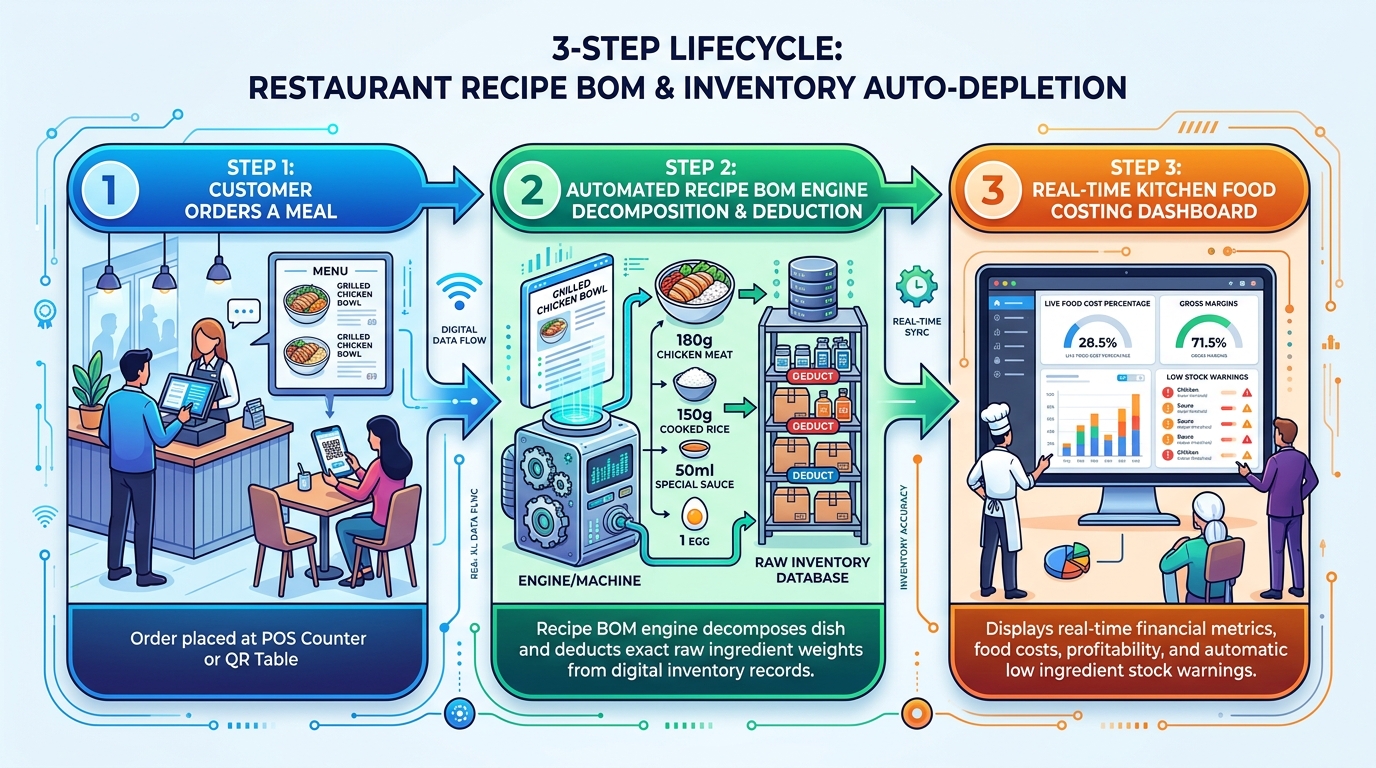
Step 1: Menu Item Sold at Point of Sale
A diner places an order at the counter or at a self-ordering kiosk. The transaction payload immediately enters the central database.
Step 2: Recipe BOM Decomposition & Granular Inventory Deduction
The engine references the active sub-recipe master file. Stock levels across storage locations (Main Prep Kitchen, Walk-in Chiller, Dry Goods Pantry) decrement with mathematical precision, eliminating manual spreadsheet logs.
Step 3: Real-Time Kitchen Food Costing Dashboard
The system recalculates live Gross Profit Margins and Cost of Goods Sold (COGS). When raw stock reaches critical par levels, automated purchase re-order flags are triggered before the kitchen ever runs out of dinner ingredients.
---
3. The Mathematics of Sustainable F&B Margins
Every professional restaurateur must benchmark their menu using the standard formula:
$$\text{Food Cost \%} = \left( \frac{\text{Raw Ingredient Cost per Portion}}{\text{Menu Selling Price}} \right) \times 100$$
In competitive dining, an ideal food cost percentage hovers tightly between 28% and 32%.
Consider an Artisan Caffe Latte:
- Espresso Beans (18g dose): RM1.10
- Fresh Steamed Milk (200ml): RM1.20
- Takeaway Cup & Compostable Lid: RM0.40
- Total Ingredient COGS: RM2.70
- Menu Retail Price: RM12.00
- Food Cost Percentage: $(2.70 / 12.00) \times 100 = 22.5\%$ (Exceptional 77.5% Gross Margin)
Without Recipe BOM governance, baristas frequently dose 24 grams and overfill milk jugs, spiking the dish food cost past 34% and quietly eroding annual net profitability.
---
4. Uncovering Kitchen Variances (Theoretical vs. Actual)
At the end of each operational cycle, GeminiPOS provides clear variance auditing:
- Theoretical Stock: What should physically remain in inventory based on exact POS sales dockets.
- Actual Physical Stock: What your staff counts during stocktake.
The difference (*Variance*) immediately pinpoints over-portioning, kitchen spillage, unrecorded comped meals, or internal inventory shrinkage, allowing operators to correct behavior before losses compound.
---
5. Transform Your Kitchen into a Profit Center
Running an F&B kitchen without automated Recipe BOM tracking is akin to running a production factory without tracking raw materials. Enforce standardized recipes, automate raw ingredient deductions, and preserve the profit margins your business deserves.
> Ready to lock in menu margins and eliminate raw ingredient waste?
> Discover how GeminiPOS empowers restaurateurs with automated recipe costing and intelligent inventory controls.
> Schedule an F&B Consultation or explore our F&B Inventory Architecture.
---
> 💡 Related Guide: Discover the complete feature overview, local-first offline architecture, and multi-outlet workflows of our flagship POS system in Malaysia built for modern retail and F&B businesses.