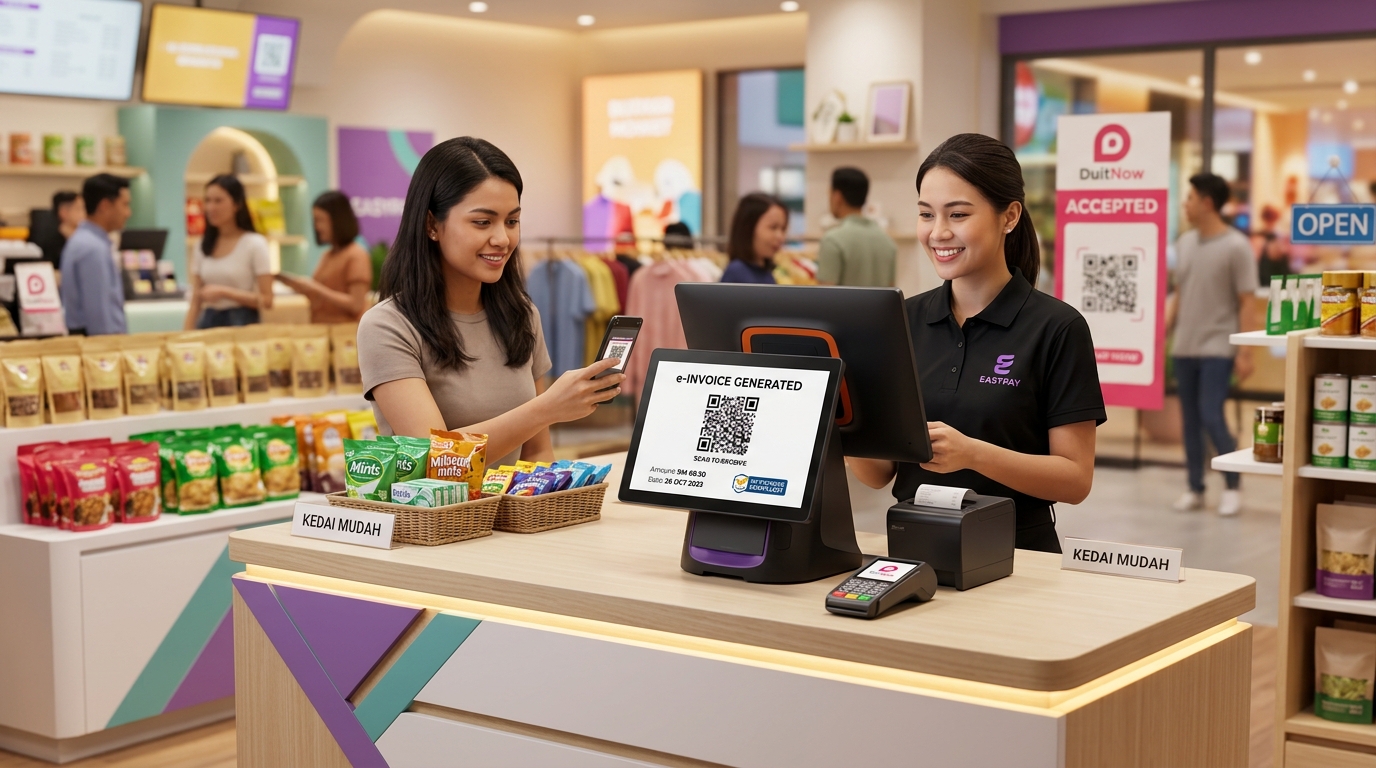
Tax authorities worldwide—from Europe's PEPPOL mandates and Latin America's CFDI to Southeast Asia's continuous transaction controls (CTC)—are rapidly transitioning to mandatory real-time electronic invoicing. For high-volume retail stores, quick-service restaurants, and hospitality operators, this regulatory shift presents a fundamental architectural challenge: How do merchants satisfy strict fiscal reporting without destroying checkout velocity?
When tax authorities require unique taxpayer identifiers and digital validation signatures for transactions, asking cashiers to manually type buyer credentials during a peak lunch rush is an operational disaster.
The industry gold standard for solving this problem is Consolidated Digital Invoicing paired with Customer Self-Service Validation Portals. Here is how modern point-of-sale architectures deliver frictionless compliance.
---
1. The Fiscal Friction Challenge in Physical Retail
In business-to-business (B2B) commerce, generating an invoice with dozens of metadata fields takes minutes and fits naturally into procurement cycles. In brick-and-mortar retail (B2C), however:
- Checkouts must execute in under 20 seconds.
- Over 85% of shoppers have no need for corporate tax documentation.
- Forcing data capture at the terminal creates massive queues, basket abandonment, and cashier fatigue.
To resolve this conflict, forward-thinking fiscal authorities provide a Consolidated Invoicing framework: transactions are recorded as standard sales receipts at checkout, while the merchant aggregates unrequested consumer sales into periodic consolidated batches transmitted directly to revenue servers.
---
2. Core Architectural Pillars of Frictionless POS Compliance
A robust, enterprise-grade tax compliance POS stack requires three coordinated architectural capabilities:
A. Edge-First Receipt Generation with Self-Service QR
Rather than requiring immediate cashier intervention, the terminal computes an encrypted transaction token and prints (or texts via WhatsApp) a dynamic QR code on the receipt. Customers requiring a formal tax invoice simply scan the code with their personal device to access a secure web portal where they enter their fiscal identification data.
B. Intelligent Time-Buffered Aggregation
The POS backend maintains a temporal ledger. Transactions remain in a claimable state for a defined grace window (e.g., 72 hours). If claimed by a verified buyer, the transaction is emitted as an individual validated e-invoice. If unclaimed upon window expiration, it is automatically sorted into the merchant's consolidated reporting bucket.
C. Automated Batch Dispatch Engine
At the close of each reporting cycle, the cloud orchestrator compiles all eligible records into canonical XML/JSON schemas, computes required cryptographic checksums, and dispatches the batch to regulatory endpoints via rate-limited worker queues.
---
3. Resilience at the Edge: Why Cloud-Only POS Fails
In many emerging markets, retail connectivity remains unpredictable. If a cloud POS relies on continuous internet access to validate fiscal receipts in real time, a severed fiber line or cellular outage brings checkout counters to an immediate standstill.
Modern engineering demands an offline-first POS architecture with local transactional caching. The point of sale must execute sales, record tax components, and generate compliance-ready receipts completely offline. When network reachability is restored, reactive data synchronization safely pushes the ledger to cloud endpoints.
---
4. Practical Implementation: The GeminiPOS Framework
By integrating our specialized e-Invoice engine with our high-speed retail POS software, business owners gain complete regulatory assurance without compromising operational throughput:
- Instant Dual-Screen & WhatsApp Receipts: Customers receive instant digital verification without wasting rolls of expensive thermal paper.
- Centralized Multi-Store Auditing: Enterprise chains monitor compliance status across all regional outlets through the unified Merchant Portal.
- Zero Hidden Costs: Transparent subscription pricing guarantees predictable operational expenditure as fiscal mandates expand.
---
5. Conclusion
Fiscal digitization is an unstoppable global regulatory wave. Rather than viewing electronic tax invoicing as an operational bottleneck, innovative merchants utilize modern point-of-sale automation to streamline ledger accuracy, eliminate manual bookkeeping, and deliver superior customer service.