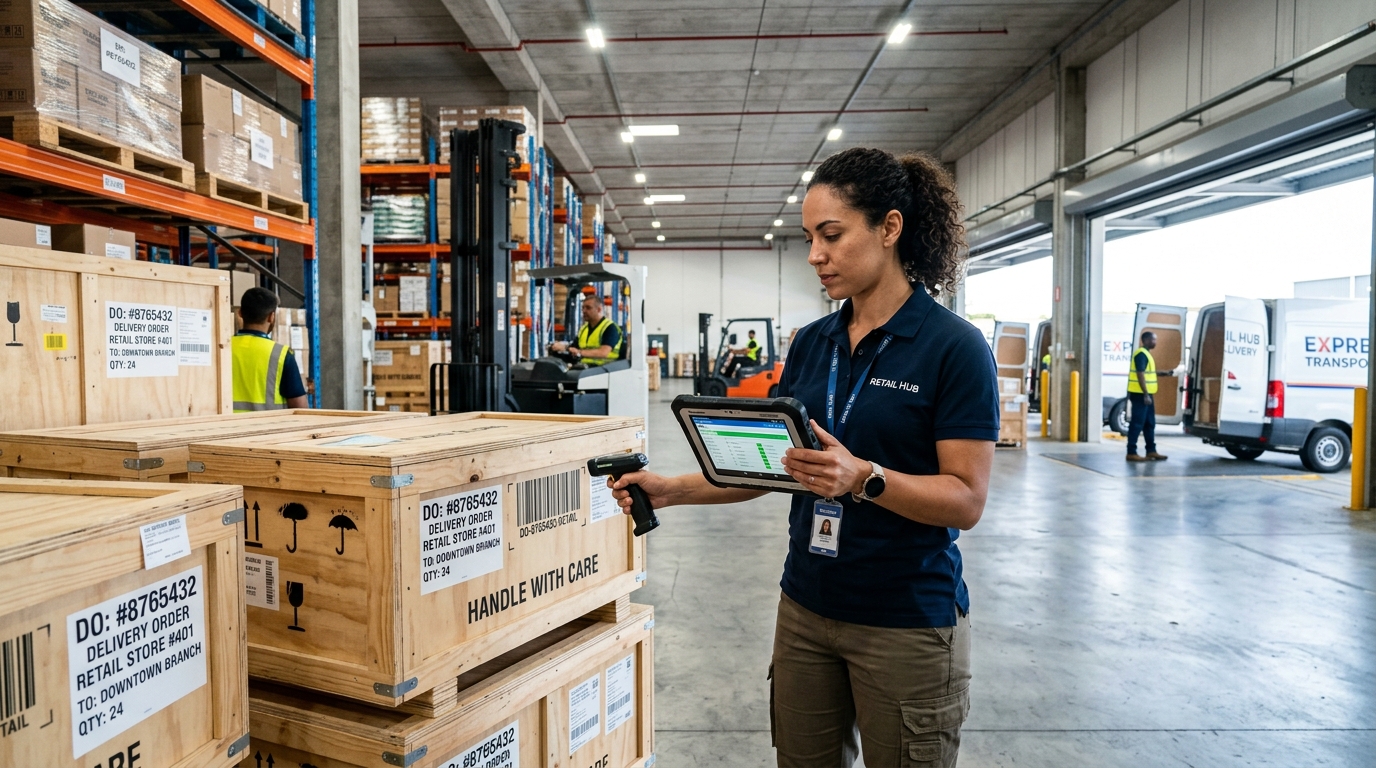
In enterprise multi-unit retail networks, inventory management ceases to be a static integer counter on a single server. It functions as a distributed, stateful, multi-node routing network.
When stock flows through a hub-and-spoke distribution topology—from regional distribution centers (RDCs) to flagship outlets, sub-stores, and micro-fulfillment nodes—the single greatest source of ledger corruption is the unaccounted-for in-transit delta.
If an architecture simply decrements Store A's database row and increments Store B's database row synchronously at dispatch, the enterprise's financial ledger misrepresents current retail asset reality. Conversely, if Store B only acknowledges stock days later without an intermediary state, goods vanish entirely from audit visibility.
Here is how modern cloud-edge point-of-sale architectures implement Double-Entry In-Transit Inventory Routing.
---
1. Architectural Model: Double-Entry Inventory State Machine
Modern retail engineering models inventory movement identically to financial double-entry bookkeeping:
!Enterprise Distributed Inventory Routing & In-Transit State Machine Diagram
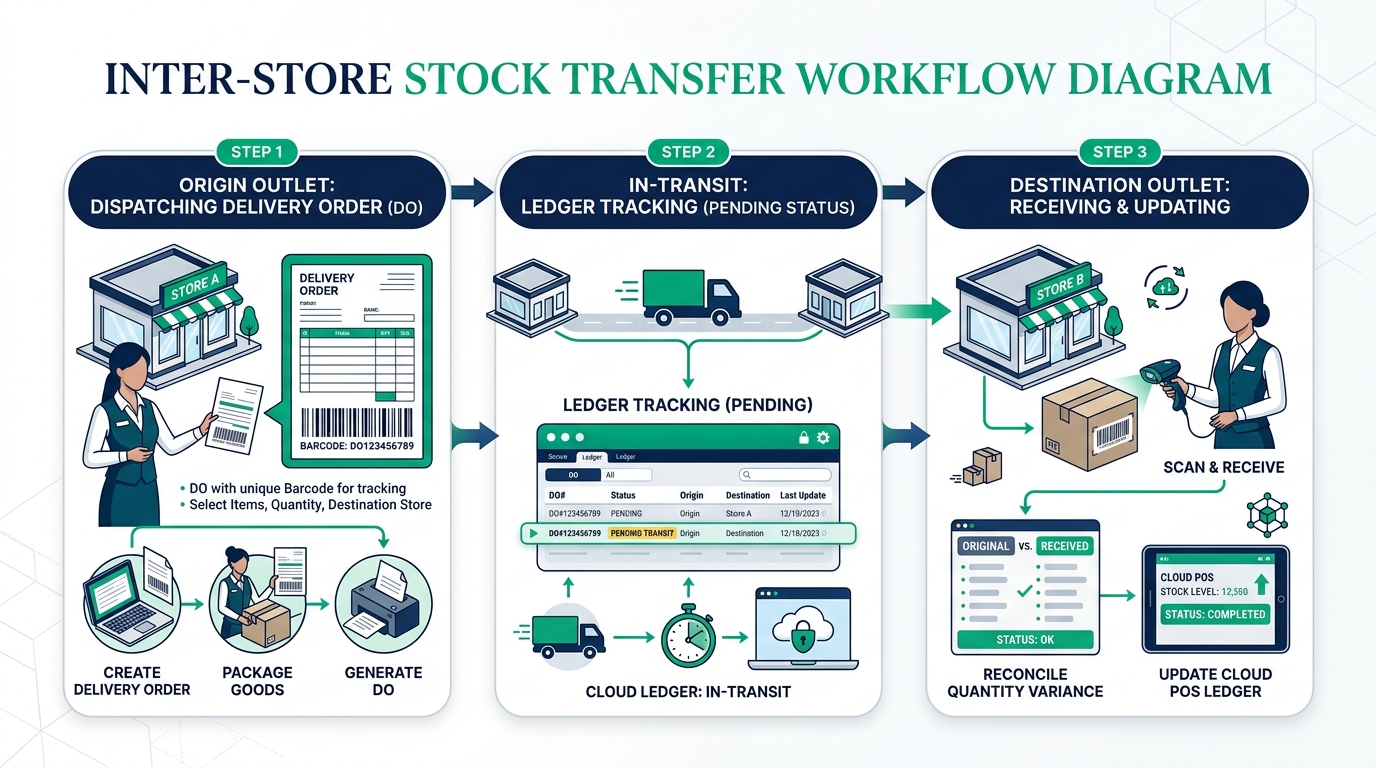
State 1: Dispatch Allocation & Outbound Manifestation
- When an outbound transfer is drafted, the designated SKUs transition from
AVAILABLEtoRESERVED_FOR_DISPATCH. - Physical packing is enforced via algorithmic barcode scanning (preventing SKU variance at the packing stage).
- Upon docket finalization, an outbound transaction atom:
$$\Delta Q_{\text{Store A}} = -k$$
$$\Delta Q_{\text{In-Transit (Doc\#)}} = +k$$
is committed to the local edge node and replicated asynchronously via event streams to the central ledger.
State 2: In-Transit Custody State
- While in transit, items are legally owned by the retail entity but cannot be promised to customer carts at either retail node.
- The docket metadata records custody handoff: carrier tracking tokens, dispatch hashes, and authorized vehicle IDs.
State 3: Blind Inbound Verification & Variance Handling
- Destination terminals require serialized scanning of incoming parcels.
- Rather than presenting the store clerk with pre-filled quantities (which encourages superficial confirmation), modern systems can enforce Blind Inbound Auditing, requiring manual barcode confirmation of each physical unit.
- If physical units received $k' \neq k$:
$$\Delta Q_{\text{Store B}} = +k'$$
$$\Delta Q_{\text{In-Transit (Doc\#)}} = -k$$
$$\Delta Q_{\text{Shrinkage/Discrepancy (Doc\#)}} = +(k - k')$$
The non-zero difference triggers an automated telemetry event and freezes the transfer ledger for operational review.
---
2. Solving the Edge-Cloud Network Disconnect
In distributed retail environments, wide-area network (WAN) fiber cuts or cellular degradation are routine realities. How does an edge POS terminal process a stock transfer when offline?
- Deterministic Edge Commit: Outbound transfers are signed locally on the Android device's SQLite database with a locally generated cryptographic UUID.
- Idempotent Queue Replay: When network connectivity is re-established, the transfer transaction is transmitted as an idempotent mutation payload. If the server already recorded the docket hash, the event is reconciled without duplicate deductions.
- Optimistic Concurrency Protection: Cross-location stock queries display transfer statuses with explicit freshness timestamps, ensuring headquarters dispatchers never route transfers against stale inventory buffers.
---
3. Comparative Architecture Matrix
Architectural Capability · Monolithic Web-Database POS · Edge-Resilient Distributed Architecture (GeminiPOS)
Transaction Processing Model · Synchronous REST write (blocks if network drops) · Asynchronous event streaming via local-first edge nodes
In-Transit Ledger Status · Often nonexistent (binary direct transfer) · Immutable intermediate custody account
Discrepancy Accounting · Requires manual spreadsheet bookkeeping adjustment · Automated variance ledger booking with photo asset binding
Outbound Scanning Precision · Manual quantity entry · Enforced sub-millisecond barcode stream parsing
Audit Traceability · Disconnected ledger rows · Cryptographically chained transfer manifests
---
4. Key Recommendations for Retail Enterprise Architects
When architecting or replacing multi-outlet POS inventory engines:
- Never Treat Transfer as a Two-Point Operation: Always maintain an explicit third node representing *In-Transit* capital.
- Enforce Cryptographic Handoff Signatures: Ensure that transfer dispatch and receipt payloads capture the operational staff's digital signature and hardware device UUID.
- Isolate In-Transit Stock from Omnichannel Allocation: E-commerce routing logic must rigorously exclude units marked *In-Transit* from online available-to-promise (ATP) algorithms until physical receipt is confirmed.
---
5. Summary & Enterprise Inquiries
Distributed inventory routing is the backbone of scalable omnichannel retail. By implementing an edge-native, double-entry transfer engine, enterprise retail networks preserve capital visibility, eradicate logistical friction, and unlock frictionless multi-node replenishment.
> Architecting resilient multi-location retail infrastructure?
> Explore how GeminiPOS delivers enterprise point-of-sale resilience with distributed inventory synchronization.
> Read our Architectural Whitepaper or Contact our Enterprise Solutions Team.