
In enterprise supply chain engineering, inventory shrinkage is often erroneously attributed to customer theft or cashier shrinkage. In reality, the largest vector of working capital depletion occurs during inbound procurement: unverified dock receiving, supplier invoice creeping, and lead-time desynchronization.
Modern distributed retail platforms treat the procurement cycle as an immutable, audited state machine.
This technical deep-dive examines how GeminiPOS implements Stochastic Reorder Point (ROP) Modeling, Barcode-Verified Receiving (GRN), and Automated 3-Way Invoice Reconciliation across distributed store clusters.
---
1. Mathematical Modeling: Dynamic Reorder Points Under Lead-Time Variance
Static reorder minimums fail because they ignore supplier volatility and demand variance. GeminiPOS computes Reorder Points (ROP) using stochastic safety stock formulation:
$$ROP = (\bar{d} \times \bar{L}) + z \cdot \sqrt{\bar{L} \cdot \sigma_d^2 + \bar{d}^2 \cdot \sigma_L^2}$$
Where:
- $\bar{d}$: Average daily unit demand (derived from localized checkout velocity).
- $\bar{L}$: Mean vendor fulfillment lead time in days.
- $\sigma_d$: Standard deviation of daily demand.
- $\sigma_L$: Standard deviation of vendor delivery lead time.
- $z$: Service level factor (e.g., $z = 1.65$ for $95\%$ non-stockout probability, $z = 2.33$ for $99\%$).
When physical stock drops below $ROP$, the replenishment daemon automatically aggregates SKUs into a draft Purchase Order (PO) structured against supplier minimum order quantities (MOQ).
---
2. Inbound Receiving State Machine & Barcode Verification
!Enterprise Replenishment Pipelines, Mobile GRN and 3-Way Invoice Matching Architecture
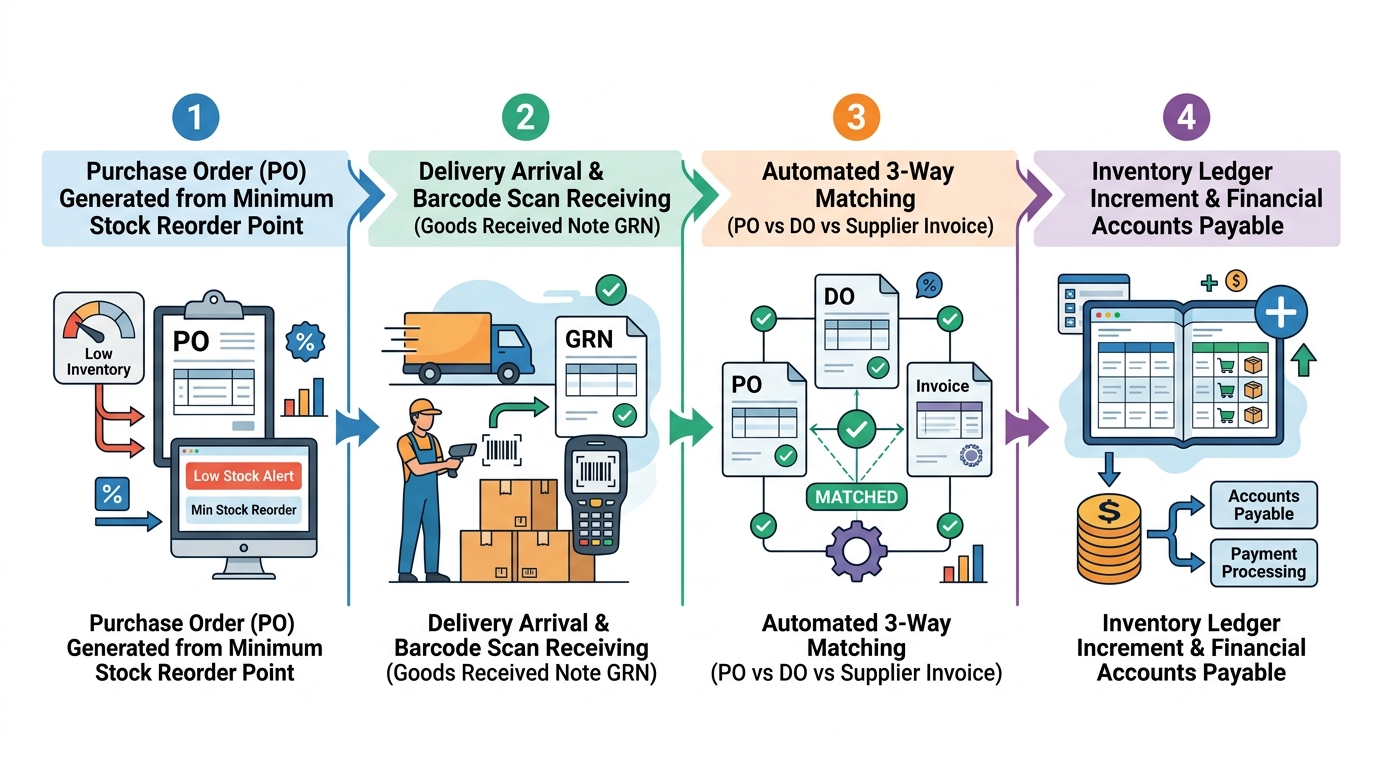
Receiving cannot be treated as a casual database update. GeminiPOS executes receiving as an atomic multi-stage state machine:
The Barcode Scan Verification Rule
- Serial / Lot Barcode Parsing: Handheld scanners decode GS1-128 or proprietary manufacturer barcodes, extracting SKU, expiration dates, and batch identifiers.
- Variance Capture: If received quantity $Q_{\text{Received}} < Q_{\text{PO}}$, the GRN automatically registers an open deficit ticket and adjusts the purchase variance account.
- Quarantine Logic: If items fail physical inspection (damaged packaging, breached cold-chain temperature thresholds), items transition to a virtual Quarantine Ledger and are prevented from broadcasting to front-of-house checkout or online Available-to-Promise (ATP) channels.
---
3. Cryptographic 3-Way Invoice Matching
To prevent invoice padding, the accounts payable pipeline requires an automated three-way consensus check before disengaging payment locks:
$$\text{MatchCondition} = \left( Q_{\text{PO}} = Q_{\text{GRN}} = Q_{\text{Invoice}} \right) \land \left( P_{\text{PO}} = P_{\text{Invoice}} \right)$$
If $P_{\text{Invoice}} > P_{\text{PO}}$ (an unauthorized supplier price escalation) or $Q_{\text{Invoice}} > Q_{\text{GRN}}$ (billing for undelivered stock), the platform automatically splits the invoice:
- Approved Base Amount: Released according to verified GRN quantities and contract rates.
- Credit Memo Demand: Dispatched to the vendor for the disputed delta.
---
4. Ledger Synchronization & Weighted Average Costing (WAC)
Upon final GRN commitment, the central ledger recalculates unit asset values using continuous Weighted Average Costing (WAC):
$$\bar{C}_{new} = \frac{(Q_{existing} \times \bar{C}_{existing}) + (Q_{received} \times P_{received})}{Q_{existing} + Q_{received}}$$
This guarantees that downstream gross margin analytics, cost of goods sold (COGS) reports, and tax declarations accurately reflect real-time inflation without manual inventory revaluations.
---
5. Architectural Comparison
Capability · Legacy ERP / Manual DOs · GeminiPOS Procurement Engine
Replenishment Calculation · Periodic human inspection · Stochastic ROP with lead-time variance modeling
Receiving Verification · Manual paper signatures · Barcode-verified handheld scanning with variance capture
Invoice Reconciliation · Manual sampling / spreadsheet audit · Algorithmic 3-way matching with automatic payment locks
Inventory Fan-Out · End-of-week batch upload · Real-time edge POS and e-commerce ATP increment
Cost Recalculation · Static cost tables · Continuous Weighted Average Costing (WAC)
---
6. Enterprise Recommendations
- Enforce Terminal-Scoped Receiving Authority: Restrict receiving privileges to authorized supervisor keys to eliminate collusion risks.
- Integrate GS1-128 Barcodes: Utilize structured barcodes at inbound receiving to capture lot numbers and expiration dates in a single scan.
- Automate Vendor Scorecards: Track supplier lead-time adherence and fulfillment variance rates to algorithmically reallocate procurement orders toward high-reliability vendors.
---
7. Conclusion
Modern retail profitability is determined at the procurement boundary. By engineering an event-driven replenishment pipeline combining stochastic ROP triggers, barcode-verified receiving, and cryptographic three-way invoice matching, retail enterprises eliminate back-door shrinkage and preserve working capital.
> Engineering resilient replenishment pipelines for your retail footprint?
> Explore how GeminiPOS powers enterprise-grade inventory and procurement architectures.
> Review our Architectural Documentation or Schedule a Technical Consultation.