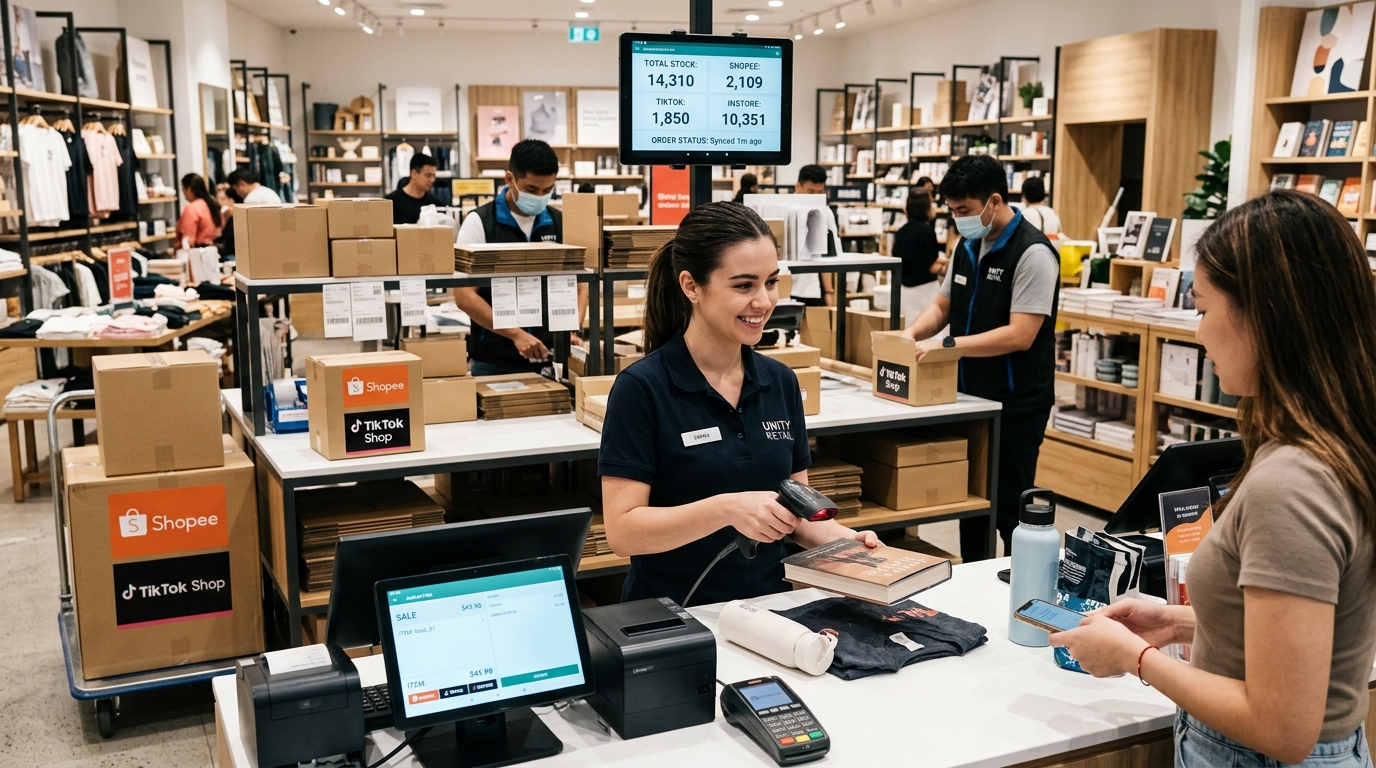
In the paradigm of Unified Commerce, inventory cannot exist as fragmented departmental silos. Modern retail enterprises must present a singular, coherent Available-to-Promise (ATP) quantity across physical brick-and-mortar checkout registers, digital web storefronts, and third-party marketplace networks.
However, unifying disparate inventory channels introduces a classic distributed systems dilemma: The Concurrent Channel Race Condition.
When an in-store shopper purchases the final available unit of an item at a physical POS register at timestamp $T_0$, there exists an unavoidable network latency window $\Delta t$ before external marketplace APIs (e.g., TikTok Shop, Shopee, Amazon) can process the catalog mutation. If a remote buyer checks out that same SKU at $T_0 + \delta t$ (where $\delta t < \Delta t$), the retail merchant suffers a catastrophic stockout failure.
On high-velocity marketplaces, merchant-initiated cancellations trigger brutal algorithmic penalties: search suppression, revocation of promotional badges, and outright merchant account suspension.
Here is how modern cloud-edge POS architectures engineer Edge-Reserved Buffer Pools and Asynchronous Webhook Defenses to eliminate marketplace overselling.
---
1. Mathematical Modeling: The Omnichannel Allocation Equation
To eradicate cross-channel race conditions, the central ledger divides physical stock on hand into three dynamic mathematical partitions:
!Unified Commerce Inventory Allocation and Dynamic Buffer Pool Architecture Infographic
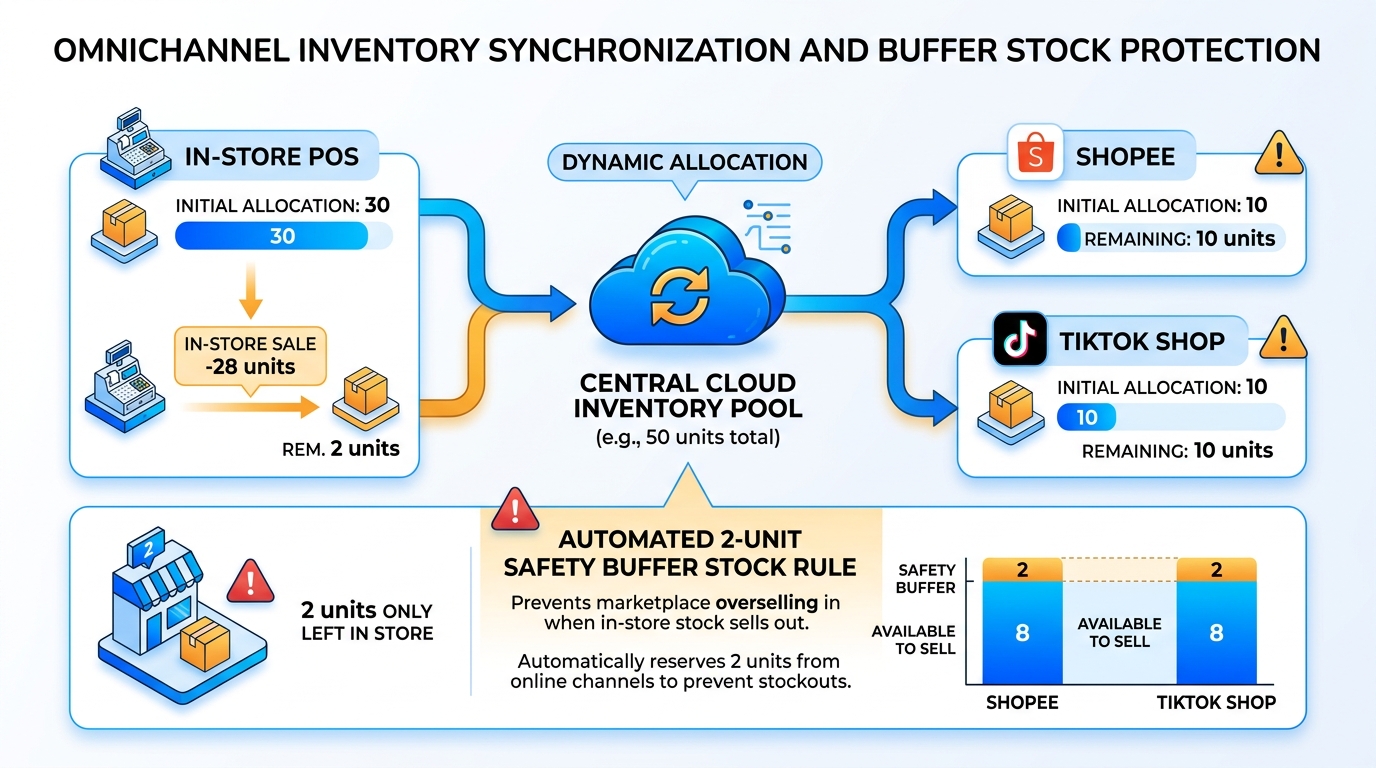
$$Q_{\text{Physical On Hand}} = Q_{\text{In-Store POS Reserved}} + Q_{\text{Marketplace ATP}} + Q_{\text{Safety Buffer}}$$
Where:
- $Q_{\text{Physical On Hand}}$: Verified physical inventory in the local branch warehouse.
- $Q_{\text{Marketplace ATP}}$: The virtual quantity broadcast via API to third-party marketplaces.
- $Q_{\text{Safety Buffer}}$: A dynamic algorithmic reserve designed to absorb network latency variance:
$$Q_{\text{Marketplace ATP}} = \max\left(0, \, Q_{\text{Physical On Hand}} - Q_{\text{Safety Buffer}}\right)$$
The Automated Zero-Out Trigger
When in-store POS volume reduces $Q_{\text{Physical On Hand}}$ such that:
$$Q_{\text{Physical On Hand}} \le Q_{\text{Safety Buffer}}$$
The system initiates an instantaneous, high-priority Zero-Out Dispatch to all external marketplace channels, broadcasting $Q_{\text{Marketplace ATP}} = 0$.
The remaining units ($Q_{\text{Safety Buffer}}$) are preserved exclusively for local in-person checkout, guaranteeing that the customer standing at the counter can finalize their transaction without any possibility of a concurrent online claim.
---
2. Solving Webhook Latency with Event-Driven Edge Pipelines
A major flaw in traditional multi-channel inventory aggregators is synchronous, blocking HTTP polling. If a system queries marketplaces every 15 minutes, the exposure window to overselling is unacceptably wide.
Modern architectures like GeminiPOS utilize an Asynchronous Event-Driven Webhook Pipeline:
- Edge-First Local Commit: When a barcode is scanned at the Android register, the deduction commits in $<5\text{ms}$ to on-device SQLite storage.
- Asynchronous Ledger Fan-Out: The transaction event streams via WebSocket to the central cloud router, which fans out parallel PATCH requests to external marketplace inventory endpoints.
- Optimistic Locking & Version Vectors: Every stock mutation carries an incremented sequence number (version vector). If marketplace network retries arrive out of order, the destination gateway discards stale updates, ensuring state consistency across wide-area networks.
---
3. Comparative Architecture Matrix
Architectural Capability · Monolithic Multi-App Middleware · Edge-Resilient Unified Commerce Engine (GeminiPOS)
Inventory Partitioning · Static rigid allocation (fragmented working capital) · Single pooled inventory with dynamic algorithmic buffer
Marketplace Update Model · Periodic batch polling (10–30 min intervals) · Real-time event streaming (<1 second API dispatch)
Race-Condition Defense · Relies on manual staff intervention · Automated $Q_{\text{Safety Buffer}}$ threshold zero-out
Offline Counter Behavior · Blocks or desynchronizes completely · Local-first deterministic checkout with atomic replay
Fulfillment Unification · Disjointed desktop apps for shipping labels · Native AWB carrier generation at checkout terminal
---
4. Key Recommendations for Enterprise Omnichannel Architects
When evaluating or designing real-time retail inventory synchronization:
- Never Broadcast Raw Physical Stock to External APIs: Always compute Available-to-Promise (ATP) through a dynamic buffer function that accounts for average channel webhook latency.
- Implement Rate-Limit-Aware Dispatch Queues: Ensure the cloud router buffers and batches rapid bursts of barcode scans to respect marketplace API rate thresholds (e.g., token bucket rate limiters).
- Unify Physical and Digital Returns: When an online order is returned to a physical store, ingest the unit into the local branch pool with an automated quarantine state before exposing it back to global marketplace ATP.
---
5. Summary & Enterprise Consultation
Unified commerce is fundamentally an exercise in distributed inventory synchronization. By pairing local-first POS execution with dynamic buffer stock algorithms, retail enterprises insulate their operations from marketplace penalties while maximizing capital efficiency across physical and digital storefronts.
> Engineering resilient omnichannel inventory pipelines across your store network?
> Discover how GeminiPOS powers enterprise retail with unified inventory synchronization.
> Review our Architectural Whitepaper or Schedule a Technical Consultation.