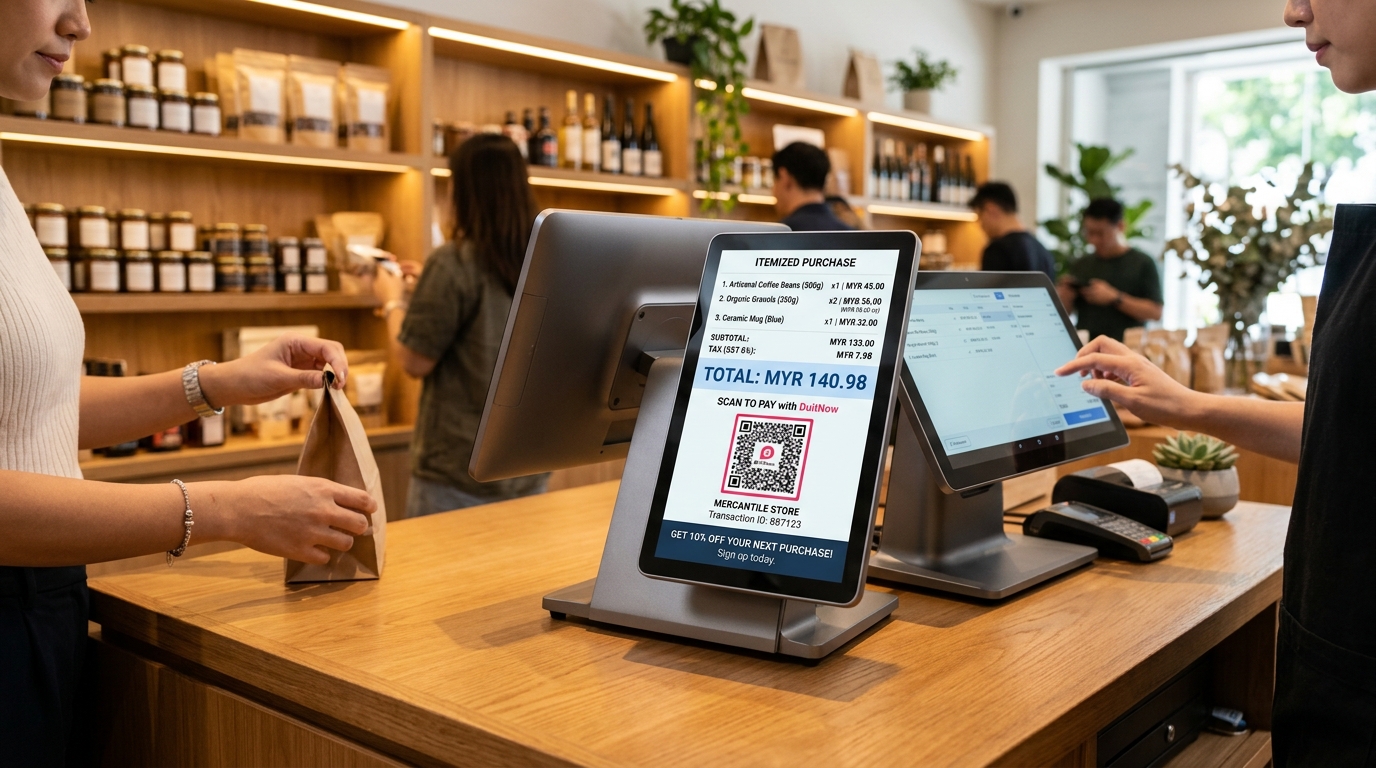
In the study of in-lane physical retail friction, few barriers generate as much customer dissatisfaction and administrative overhead as transactional opacity.
When cash registers isolate the consumer behind a static monitor chassis:
- Shoppers experience an information asymmetry deficit regarding item pricing, multi-buy promotional triggers, and tax calculations.
- Line discrepancies discovered after receipt printing result in expensive manager overrides, lane downtime, and queue abandonment.
- Static payment setups force shoppers into clumsy, error-prone manual amount entries on their mobile devices.
Modern enterprise point of sale architectures resolve these vulnerabilities by standardizing on Dual-Screen Customer-Facing Displays (CFD) linked via reactive event buses.
---
1. Architectural Blueprint: The Reactive Dual-Screen Topology
In a decoupled POS architecture, the secondary screen is not simply an auxiliary HDMI mirror—it is an independent, state-reactive presentation layer:
!Dual-Screen Customer Facing Display (CFD) System Flow Infographic
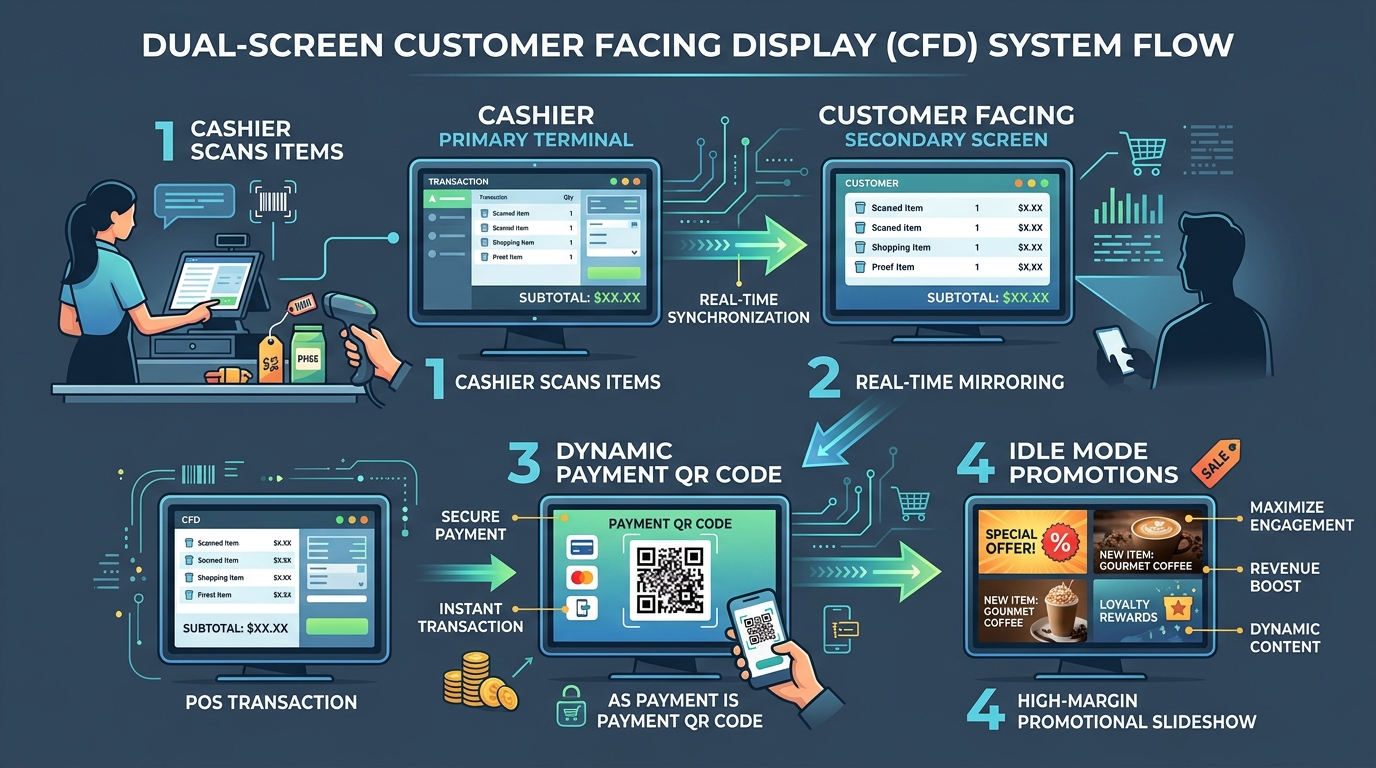
1. Zero-Latency Reactive State Projection
The core application state (managed via unified ViewModels or StateFlows) projects distinct UI models across primary and secondary screens:
- Cashier Primary Screen: Optimized for operational density—barcode scanning queues, tender options, cash drawer controls, and staff authentication.
- Customer Secondary Screen: Optimized for clarity and elegance—dynamic line-item cards, total tax breakdowns, loyalty progress bars, and localized multilingual typography.
2. Encrypted Dynamic QR Code Settlement
Dynamic QR generation eliminates the systemic security flaws of static payment identifiers:
- The checkout system constructs an encrypted, ephemeral payment payload encoding the precise transaction total, currency, and merchant routing ID down to the fraction of a cent.
- The CFD renders this dynamic payload instantly upon tender selection.
- The consumer scans and confirms without keyboard entry, cutting tender duration by over 65% and completely immunizing the business against payment fraud.
3. Edge-Managed Digital Signage Integration
During idle lane windows:
- The CFD transitions into an edge-cached digital out-of-home (DOOH) promotional billboard.
- High-resolution promotional video assets loop locally without consuming WAN bandwidth, delivering relevant merchandise impressions at the most valuable point in the physical retail journey.
---
2. Technical Capabilities Matrix
Architectural Feature · Legacy Single-Screen POS · GeminiPOS Reactive Dual-Screen CFD
Display Communication Bus · None · Reactive Local Inter-Process Event Bus
Payment QR Generation · Static printed counter decals · Ephemeral dynamic QR with exact transaction payload
Shopper Fraud Exposure · Susceptible to spoofed transaction screenshots · Deterministic asynchronous settlement confirmation
Idle Lane Asset Delivery · Static printed cardboard signs · Centrally managed edge-cached digital signage loops
Data Privacy Compliance · Cashier verbally asks for PII (phone/email) · Customer inputs private data directly on secondary touchscreen
---
3. Operational and Financial ROI
Deploying enterprise customer-facing displays delivers immediate, auditable commercial advantages:
- Eradication of Void Overhead: In-flight basket verification by the shopper reduces post-tender void authorizations by up to 82%.
- Queue Throughput Optimization: Instantaneous dynamic QR scanning reduces transaction settlement time by an average of 8 to 12 seconds per customer.
- First-Party Membership Conversion: Shoppers exhibit significantly higher willingness to input their contact details on an interactive touch display compared to verbally disclosing personal info across a crowded counter.
---
4. Conclusion & Enterprise Advisory
The point of sale checkout lane is the final and most impressionable touchpoint of the physical customer journey. By unifying dual-screen hardware ergonomics with reactive customer-facing software, retail enterprises secure payments, eliminate operational friction, and elevate the standard of in-store customer service.
> Modernizing checkout lane ergonomics and customer transparency across your enterprise network?
> Explore how GeminiPOS pairs commercial dual-screen hardware with enterprise software resilience.
> Review our Architectural Whitepaper or Contact our Enterprise Engineering Team.