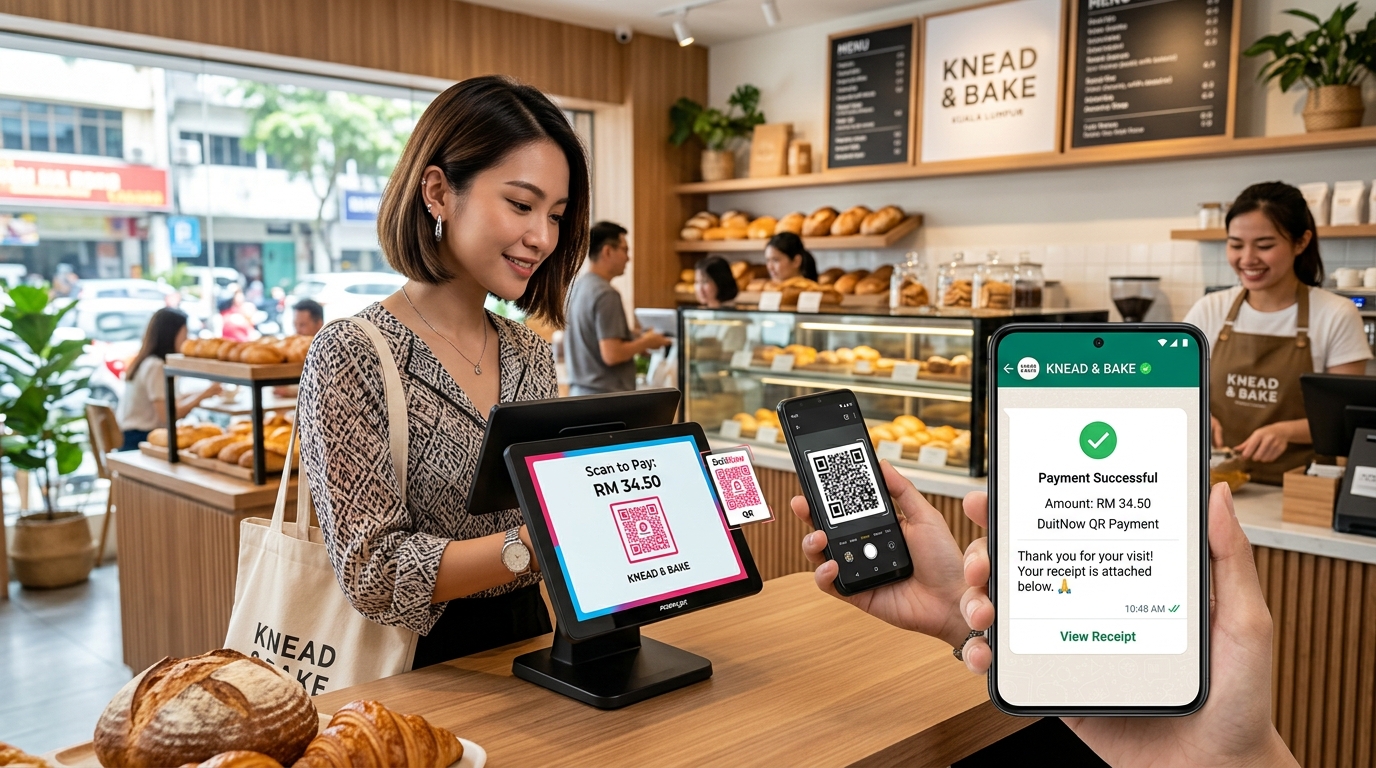
QR payments via DuitNow, mobile banking apps, and digital wallets have become the standard payment expectation across Malaysian retail and hospitality. However, this shift has introduced two major operational pain points for brick-and-mortar merchants:
- The 'Fake Screenshot' Transfer Scam: Fraudulent customers presenting edited banking screens or historic transaction receipts to busy cashiers.
- Escalating Thermal Receipt Paper Costs: Retailers spending thousands of ringgit annually on disposable, chemical-coated thermal paper rolls that quickly fade and end up in the trash.
Here is how modern Malaysian merchants are tackling both challenges using dynamic checkout verification and automated WhatsApp digital receipts.
---
The Flaw of Static Counter QR Codes
Many small retail shops and cafes still display a laminated, static DuitNow QR stand on their front counters:
- The customer scans the QR and manually types in the ringgit amount.
- They flash their phone screen showing "Payment Successful" for a fraction of a second.
- During a noisy lunch rush or busy weekend, cashiers glance quickly, assume the payment cleared, and hand over the items.
- At end-of-day reconciliation, the business owner discovers hundreds of ringgit in missing sales. The customer had merely presented a doctored screenshot created via scam apps or Telegram bots.
---
The Solution: Dynamic POS QR & Integrated Verification
Eliminating payment fraud requires removing human visual verification from the checkout loop:
Checkout Dimension · Static Counter QR Stand · Dynamic POS-Driven Verification
Amount Entry · Customer inputs manually (prone to underpayment) · POS pushes exact subtotal to display/terminal
Payment Confirmation · Cashier peers at customer phone screen · POS server receives direct webhook from provider
Receipt Trigger · Cashier presses complete manually · Receipt only prints once payment is verified
Fraud Vulnerability · High during rush hours · Zero risk of doctored screenshot fraud
With a connected POS system, checkout only finalizes when the payment provider issues a cryptographically verified confirmation callback.
---
Cutting Costs: The Financial Drain of Thermal Paper
Beyond fraud, paper receipts represent an invisible recurring drain on retail margins:
- A standard carton of thermal paper (50 rolls of 80mm or 58mm) costs between RM65 and RM90.
- A high-turnover outlet easily burns through 3 to 5 cartons every month.
- That amounts to RM2,500 to RM4,500 every year spent on paper that customers discard immediately upon leaving the store.
- Furthermore, thermal paper is coated with bisphenol chemicals (BPA/BPS) and fades completely within a few months, making warranty claims and tax expense audits a nightmare.
The Power of Automated WhatsApp Digital Receipts
GeminiPOS integrates seamless digital receipt delivery directly to your customer's WhatsApp:
- Zero Consumable Overhead: Slash paper roll purchases by up to 80% by reserving thermal printing only for customers who explicitly request a physical slip.
- Permanent, Searchable Record: The customer retains an indelible record of their purchase, complete with SKU details, return policies, and an embedded LHDN e-Invoice QR code.
- Direct Engagement: WhatsApp receipts provide a non-intrusive channel for customer service, feedback, and re-orders.
- Green Retail Branding: Customers appreciate environmentally conscious brands that actively reduce chemical paper waste.
---
Tactical Action Plan for Store Managers
- Audit Counter Vulnerabilities: Replace static desk QR codes with dynamic QR displays or terminal-integrated prompts.
- Enable Digital Receipt Options: Configure your POS to prompt customers for WhatsApp receipt delivery at checkout.
- Train Cashiers on Operational Safeguards: Ensure staff understand that a customer's phone screen is never official proof of payment.
Explore GeminiPOS for Malaysian retail, review our payment integration guides, and explore transparent pricing plans.