
In service-centric retail environments—such as hair salons, aesthetic clinics, automotive detailing workshops, bespoke tailors, and luxury boutiques—staff commissions represent the primary catalyst for revenue growth.
Yet for most business operators, closing monthly books remains a stressful ordeal:
> *"It is midnight on the 28th. The store owner is buried under piles of paper receipts and disjointed Excel sheets. Stylist A insists she handled the high-ticket rebonding treatment, while Junior Assistant B argues he performed the extensive hair wash and toner application. When paychecks arrive, resentment festers, staff question management integrity, and top performers threaten to walk out."*
Disputes over unrecorded commissions and manual calculation errors remain a leading driver of employee turnover in Southeast Asian retail.
High-performing businesses resolve this friction by embedding Real-Time Commission Tracking and Split Attribution directly into their point-of-sale checkout engine.
---
1. The Operational Pitfalls of Spreadsheet Commissions
Managing sales incentives outside your transactional database introduces structural vulnerabilities:
- Split-Service Complexity: In service retail, customer treatments frequently involve multiple staff members (e.g., Lead Mechanic 75%, Apprentice 25%). Splitting these line items manually across hundreds of invoices is highly error-prone.
- Gross Margin vs. Revenue Distortions: Flat commission rates fail when selling high-margin services alongside low-margin retail products. A 10% commission on a 50% gross-margin haircut is healthy, but that same 10% on a 12% margin imported shampoo erodes net profitability.
- Tiered Milestone Tracking: Tiered incentives (e.g., 5% base commission up to RM15,000 monthly sales, jumping to 8% once targets are exceeded) require dynamic tier boundaries that spreadsheets frequently miscalculate.
- Payroll Reconciliation Friction: Transcribing monthly commission totals from spreadsheets into payroll software consumes days of clerical labor and invites transcription errors.
---
2. The GeminiPOS Automated Commission Workflow
By unifying staff attribution with POS checkout transactions:
!Automated Staff Commission Workflow, Split Attribution and Direct Payroll Sync
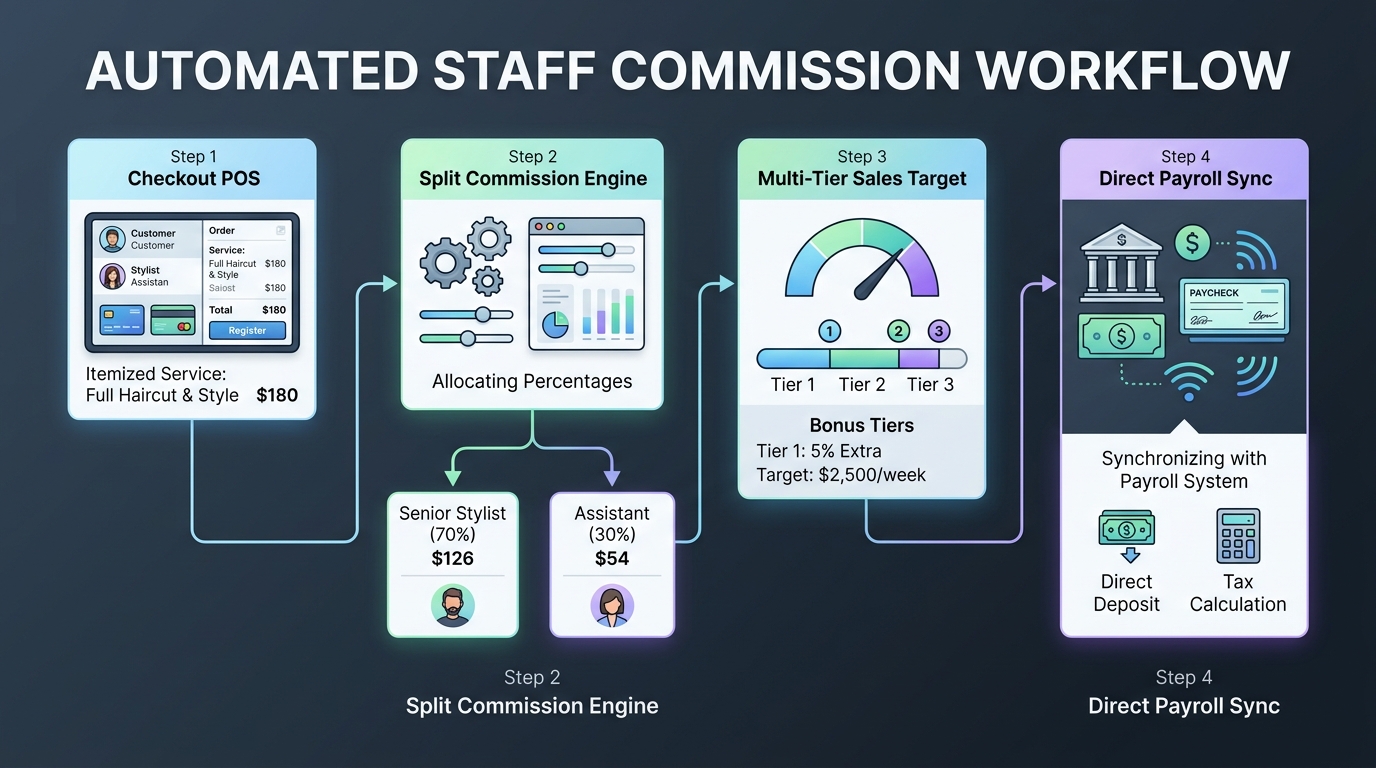
Step 1: Real-Time Technician Tagging at Checkout
When ringing up items at the counter:
- Cashiers select the active technician or salesperson directly on the line item.
- For collaborative jobs, staff engage Split Attribution with a single tap, defining custom contribution splits (e.g., Senior Stylist 70%, Assistant 30%).
Step 2: Algorithmic Commission Evaluation
The moment payment completes:
- GeminiPOS evaluates item classification and applies deterministic commission formulas (Fixed Currency Amount or Percentage of Net Price).
- Commission allocations are immutably logged to the employee ledger, establishing a tamper-proof audit trail.
Step 3: Transparent Staff Portals & Gamified Leaderboards
- Technicians can independently inspect their personal daily accumulated commission directly on their terminal PIN login.
- Store managers monitor real-time Sales Performance Leaderboards from anywhere via mobile dashboards, recognizing top performers and identifying coaching opportunities.
Step 4: One-Click Statutory Payroll Integration
At the close of the payroll cycle:
- Commission totals automatically feed into the MyStore Malaysian Payroll Engine.
- The platform calculates base salaries, commissions, overtime, and statutory contributions (EPF, SOCSO, EIS, and PCB) with zero duplicate data entry.
---
3. Comparative Analysis: Manual Spreadsheets vs. GeminiPOS Engine
Operational Dimension · Manual Excel Spreadsheets · GeminiPOS Commission Engine
Monthly Computation Time · 2 to 4 full working days · Zero seconds (Real-time calculation)
Split-Service Accuracy · Frequent disputes and guesswork · Exact programmatic split per line item
Margin Protection · Often ignores underlying product margin · Role- and category-specific percentage rules
Staff Transparency · Opaque; only visible on payday · Real-time daily visibility on terminal login
Payroll Ingestion · Manual export and manual re-typing · Direct push to statutory payroll ledger
---
4. Implementation Best Practices
- Standardize Role-Based Commission Profiles: Establish clear commission rules by employee rank (Junior, Senior, Master Stylist) and item category.
- Adopt Clear Split Ratios: Create predefined split templates for common joint services to streamline cashier workflow during peak hours.
- Leverage Live Transparency to Boost Productivity: Encourage staff to review their daily metrics, fostering healthy competition and driving upselling.
- Enforce Manager Approvals for Overrides: Require supervisor authorization for manual commission rate changes to maintain financial integrity.
---
5. Conclusion
Staff trust is the bedrock of service retail. By replacing chaotic paper slips and fragile spreadsheets with automated, transparent commission tracking, retail operators protect their margins, eliminate toxic workplace disputes, and empower high-performing talent.
> Ready to modernize commission management across your locations?
> Discover how GeminiPOS unifies checkout, commission attribution, and payroll.
> Explore Staff & Payroll Management or Schedule an Executive Consultation.
---
> 💡 Related Guide: Discover the complete feature overview, local-first offline architecture, and multi-outlet workflows of our flagship POS system in Malaysia built for modern retail and F&B businesses.