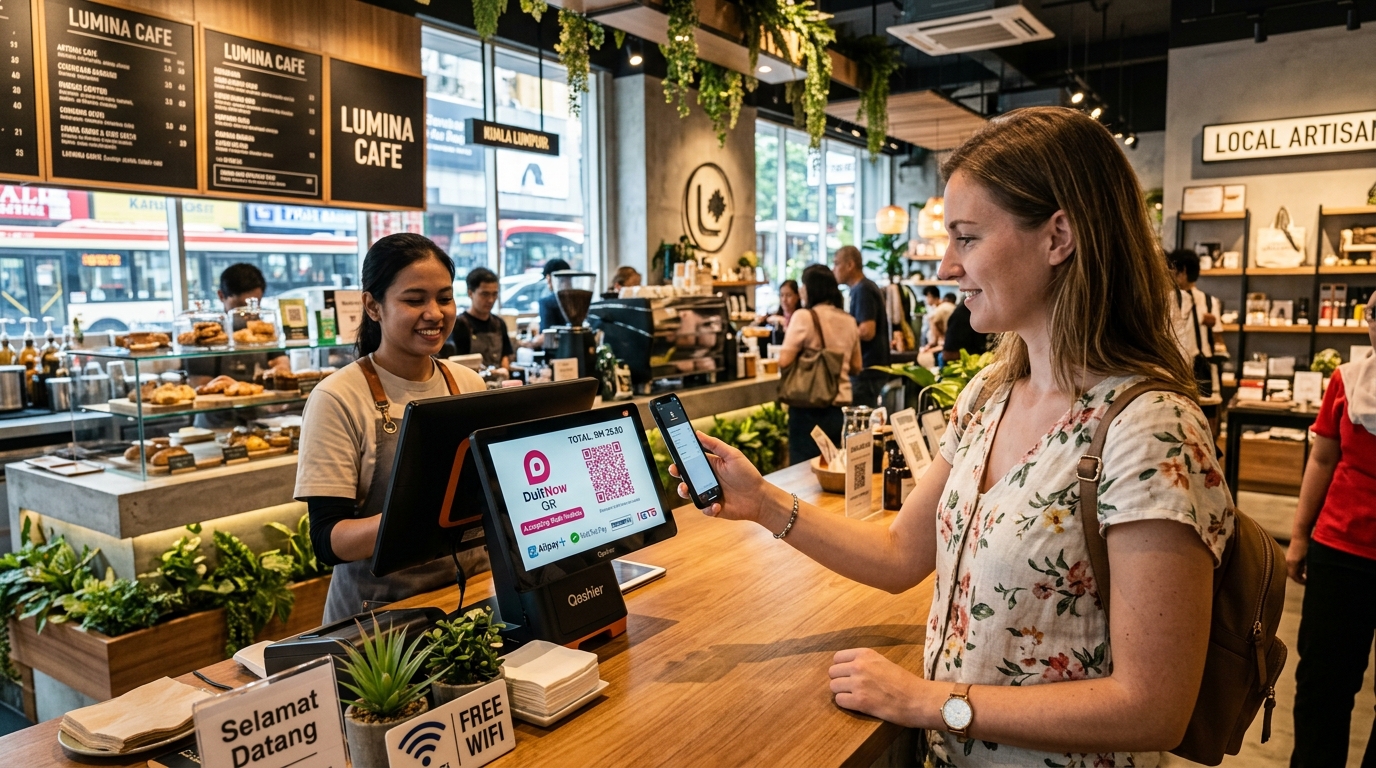
Malaysia is experiencing a dramatic influx of international travelers from China, Singapore, Thailand, Indonesia, and across the Asia-Pacific corridor. Retailers, dining venues, and boutique operators in prime tourist enclaves—such as Kuala Lumpur City Centre, Penang's George Town, Melaka's Jonker Walk, and Johor Bahru—frequently face a common counter dilemma:
> *"A Chinese visitor asks to pay with Alipay or WeChat Pay. A Singaporean tourist pulls out their phone to scan NETS or PayNow. A traveler from Bangkok wants to pay via PromptPay. The cashier has to decline because the counter only accepts cash or physical cards burdened with hefty foreign exchange transaction surcharges."*
The merchant loses an immediate high-margin sale, while the international visitor leaves disappointed.
Traditionally, accepting these foreign digital wallets required merchants to rent standalone EDC card terminals from acquiring banks, incurring monthly equipment lease fees of RM50 to RM80 per terminal, plus complex multi-terminal reconciliation overhead.
With the GeminiPOS Cross-Border QR Payment Gateway, merchants can accept sovereign tourist wallets directly on existing Android POS screens with zero monthly terminal rentals!
---
1. Cross-Border QR Payment Routing Architecture
!Cross-Border QR Payment Routing Architecture Flow Diagram
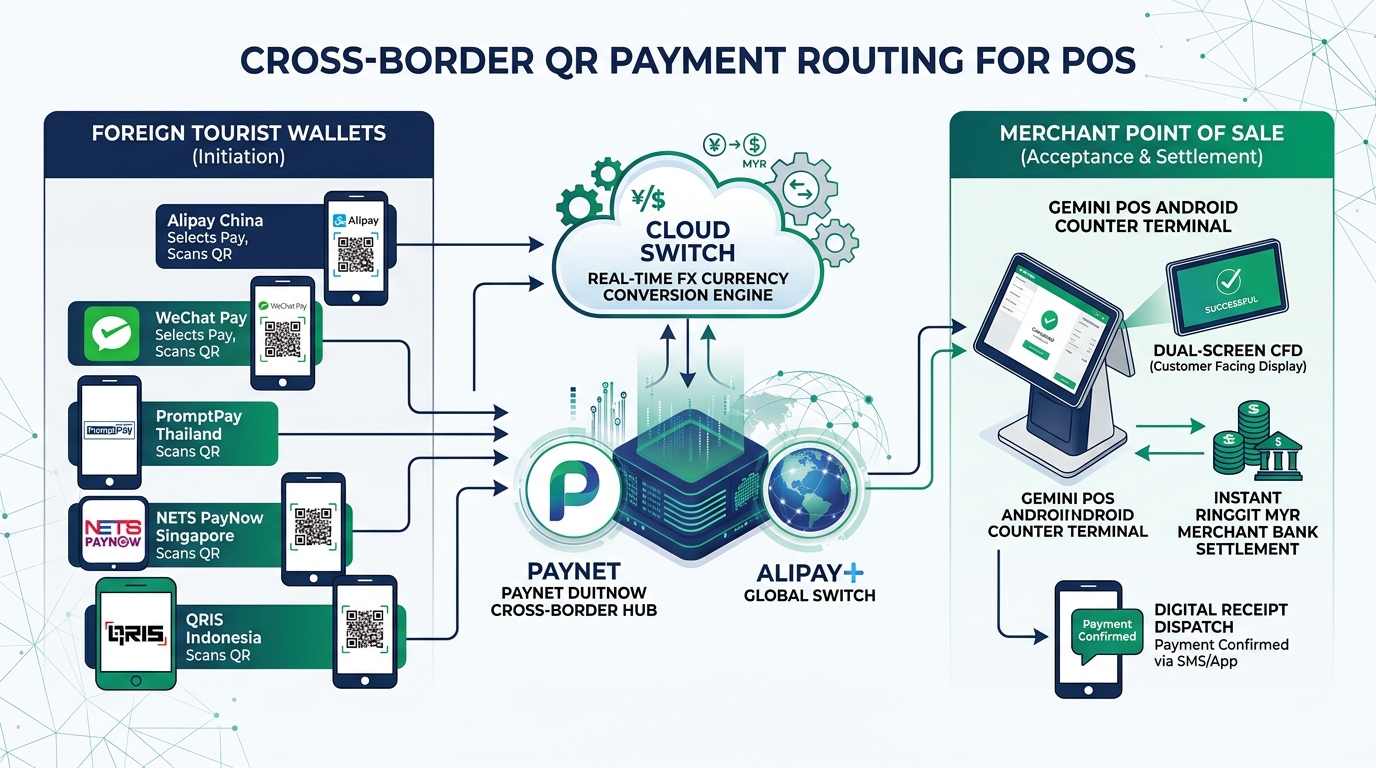
GeminiPOS orchestrates seamless connectivity with international payment switching networks (PayNet DuitNow Cross-Border and the Alipay+ Global Switch):
---
2. Comprehensive International Wallet Matrix
A single Dynamic QR Code displayed on the Customer Facing Display (CFD) or printed thermal checkout slip enables friction-free acceptance across top visitor demographics:
Visitor Origin · Supported Mobile Wallets & Banking Apps · Clearing Rail / Gateway · Debited Currency
Mainland China · Alipay, WeChat Pay · Alipay+ / PayNet Bilateral · Chinese Yuan (CNY)
Singapore · NETS, PayNow, OCBC Pay Anyone, DBS PayLah! · PayNet-NETS Cross-Border Rail · Singapore Dollar (SGD)
Thailand · PromptPay, Bangkok Bank, Kasikorn, SCB · PayNet-PromptPay Bilateral Switch · Thai Baht (THB)
Indonesia · QRIS, GoPay, OVO, Dana, BCA Mobile · PayNet-QRIS Interoperability Rail · Indonesian Rupiah (IDR)
Hong Kong / Macau · AlipayHK, WeChat Pay HK, MPay · Alipay+ International Network · Hong Kong Dollar (HKD)
The tourist scans the dynamic code using their native home-country app. The deduction is converted transparently at institutional exchange rates, while the merchant's Malaysian business bank account receives 100% Malaysian Ringgit (MYR) with zero currency fluctuation risk!
---
3. Core Advantages Over Legacy Bank EDC Terminals
A. Zero Monthly Rental & Hardware Bloat
Acquiring banks charge recurring equipment fees for every physical EDC terminal. For a boutique or restaurant running three branches with two checkout lanes each, hardware leasing bleeds RM300 to RM480 every month. GeminiPOS unlocks cross-border acceptance purely through software on existing hardware.
B. Dynamic QR Prevents Fake Screenshot Fraud
Unlike static printed QR stickers pasted onto acrylic counter stands—which are vulnerable to fake payment screenshot deception:
- GeminiPOS computes a Dynamic QR bound to the exact basket total.
- The transaction authorizes and clears within 2 seconds.
- The POS terminal provides audio and visual confirmation, automatically popping the cash drawer or printing an itemized receipt.
C. Unified Single-Ledger Reconciliation
Instead of manually matching paper batch slips from three different bank merchant terminals at midnight:
- Local DuitNow QR, international tourist wallets, credit cards, and cash settle into a Single Consolidated Sales Report.
- Owners access detailed analytics categorizing sales by visitor country of origin, empowering data-driven tourist marketing campaigns.
---
4. Simple 4-Step Activation Workflow
- Open Payment Settings: Inside MyStore Web Admin, navigate to *Settings* → *Payment Gateways*.
- Enable Cross-Border QR: Toggle on *DuitNow Cross-Border & Alipay+ Network*.
- Link Settlement Bank Account: Input your corporate business banking details (Maybank, CIMB, RHB, etc.) for next-business-day automatic payout.
- Initiate Acceptance: Your Android checkout screen immediately accepts sovereign mobile wallets from millions of international travelers!
---
5. Summary Matrix
Operational Capability · Standalone Bank EDC Terminal · GeminiPOS Software-Defined QR
Monthly Hardware Cost · RM50 – RM80 per device lease fee · RM0 (Runs on existing Android POS)
Authorization Speed · 5 – 10 seconds (card swipe & print) · 1 – 2 seconds (dynamic QR scan)
Tourist UX · Card chip errors & foreign bank rejections · Native home banking app familiar to buyer
Daily Close Reconciliation · Manual paper batch settlement roll · Automated real-time cloud ledger sync
---
6. Conclusion
Unlocking international traveler spending should never depend on expensive hardware contracts. By implementing dynamic cross-border QR payment capabilities inside GeminiPOS, your retail and dining outlets can welcome visitors from across Asia effortlessly—maximizing ticket sizes while keeping overhead lean.
> Ready to Welcome International Travelers at Your Counter?
> Learn how GeminiPOS turns your checkout terminal into a global payment hub without extra hardware costs.
> Explore Payment Solutions or Book a Live Demo.
---
> 💡 Related Guide: Discover the complete feature overview, local-first offline architecture, and multi-outlet workflows of our flagship POS system in Malaysia built for modern retail and F&B businesses.