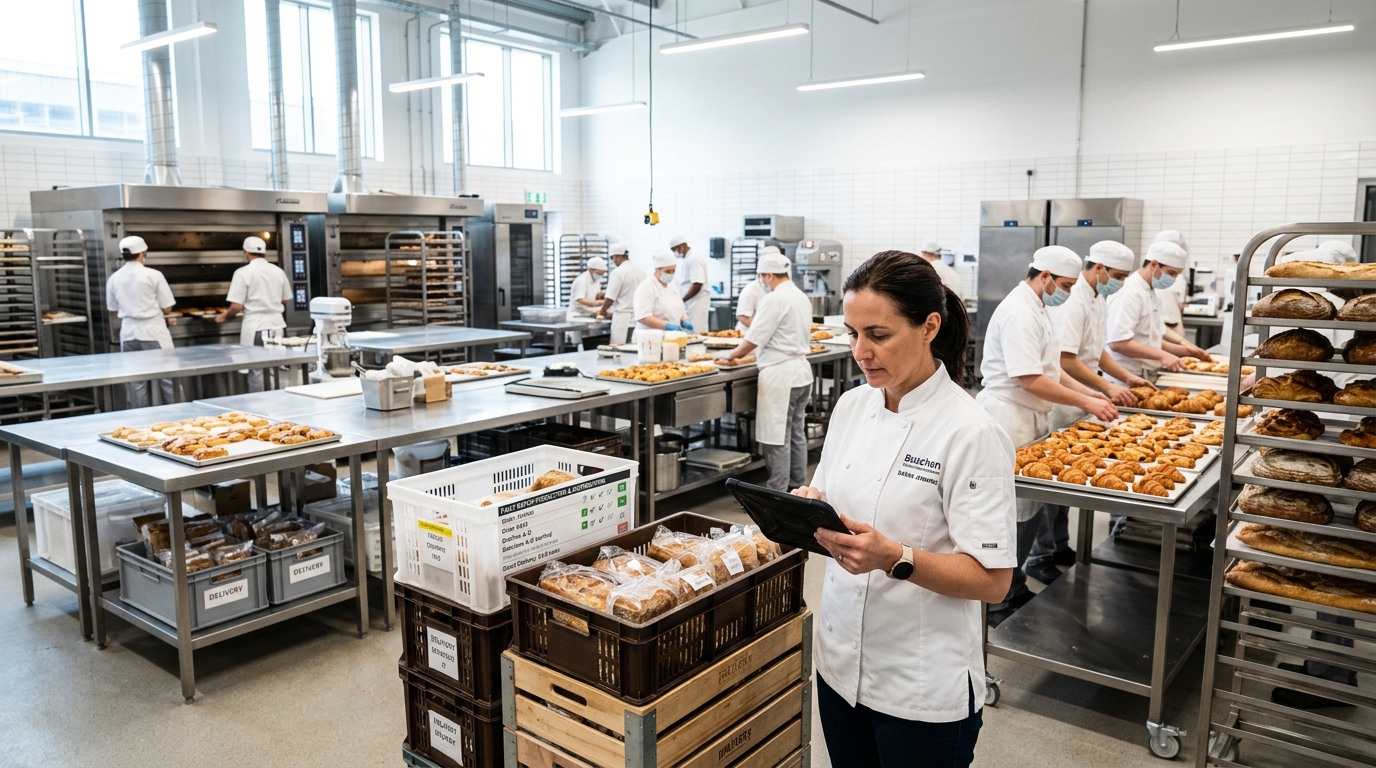
Scaling an F&B enterprise from an artisan shop into a multi-unit bakery chain or restaurant franchise requires centralized culinary production. Establishing a Commissary or Central Kitchen is the standard mechanism to ensure culinary consistency and realize bulk purchasing economies of scale.
Yet commissary production introduces formidable supply-chain complexities:
> *"At 3:30 AM, the head baker kicks off a massive batch run: 800 artisanal croissants, 400 baguettes, and 500 meat pies slated for delivery to seven downtown outlets. Raw flour, butter, and yeast are withdrawn based on loose memory rather than audited records.*
> *During baking, an oven thermostat failure ruins 45 baguettes (unrecorded shrinkage). Later, when the delivery van drops off crates at the flagship branch, the store supervisor insists only 85 baguettes arrived instead of the invoiced 100.*
> *By the end of the quarter, the commissary reports unexplained ingredient losses worth tens of thousands of dollars!"*
Unmonitored recipe ingredient leakage, undetected batch yield degradation, and informal inter-unit transport severely undermine commissary margins.
High-performing food chains resolve these vulnerabilities using the GeminiPOS Automated Daily Production & Multi-Unit Dispatch Engine.
---
1. The Three Structural Failures of Traditional Commissaries
- Manual Bill-of-Materials (BOM) Calculation: Computing raw material requirements across dozens of finished goods using whiteboards or spreadsheets inevitably results in inventory discrepancies and stockouts.
- Invisible Yield Loss: Cooking and baking involve natural physical evaporation, thermal shrinkage, and defective goods. Failing to track the delta between theoretical yield and actual packaged output obscures the true Cost of Goods Sold (COGS).
- Paper-Based Fleet Transfers: Dispatching goods via handwritten Delivery Orders (DOs) exposes logistics to cargo theft and transit loss, leaving store managers and delivery drivers locked in constant disputes.
---
2. The GeminiPOS Daily Production Lifecycle
Driven by the DailyProductionPage module in MyStore:
!Central Kitchen Commissary Production Pipeline, Batch Yield Tracking and Multi-Branch Dispatch
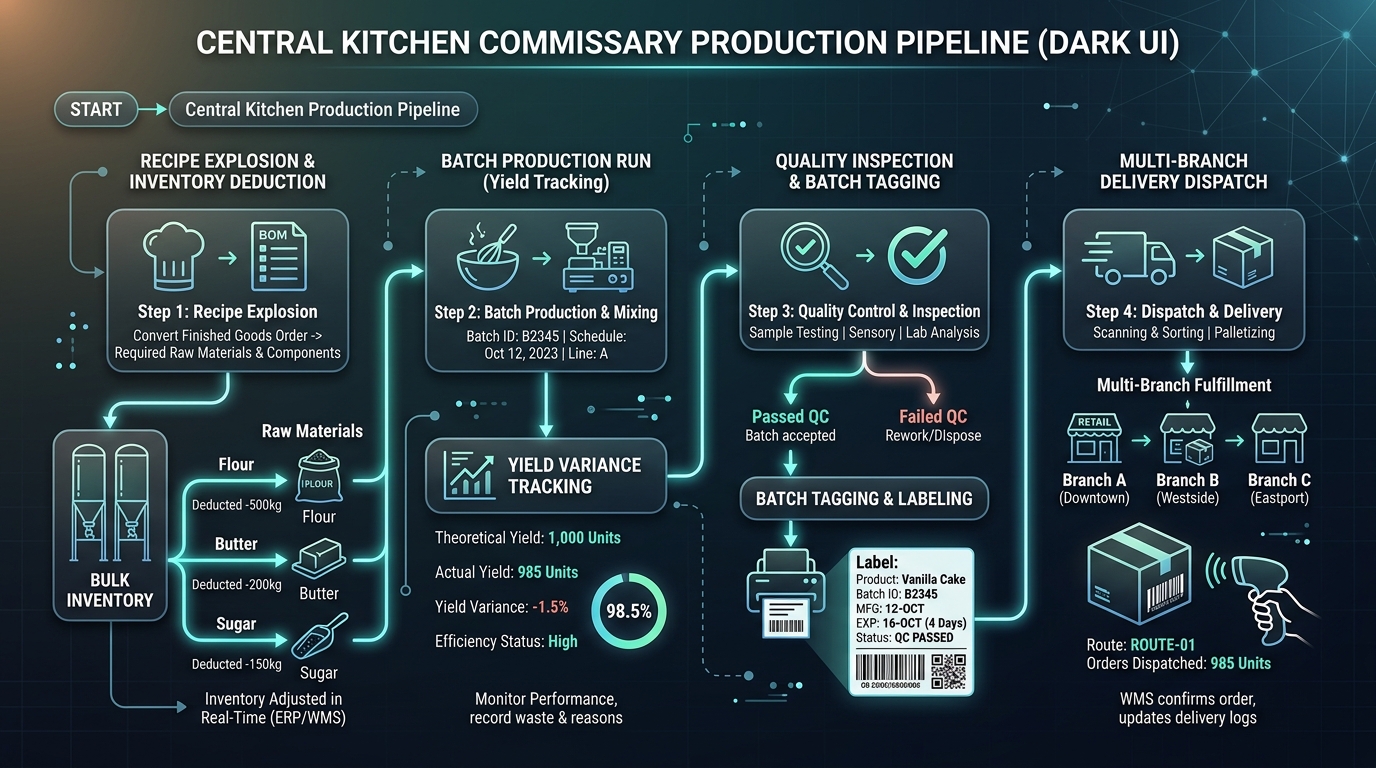
Stage 1: Demand Aggregation & Batch Scheduling
Branch managers submit daily replenishment requisitions directly through their POS terminals:
- GeminiPOS consolidates store orders into an optimized master run: e.g., Branch North requires 150 croissants, Branch South requires 250 → Batch Schedule: 400 Units.
- Production assigns an immutable Batch ID (#B2345) with scheduled baking lines.
Stage 2: Automated Recipe Explosion & Ingredient Allocation
With one click:
- The system interrogates the finished good's Bill of Materials (BOM) and deducts precise metric quantities of bulk raw materials (flour, sugar, butter) from central warehouse stock.
- The raw inventory ledger updates in real time, preventing unauthorized stockroom withdrawals.
Stage 3: Actual vs. Theoretical Yield Variance Auditing
Upon completion of the production cycle:
- Kitchen supervisors log the final count of items that pass Quality Control (QC).
- The system dynamically computes the Batch Yield Efficiency Ratio:
$$\text{Yield Ratio} = \left( \frac{\text{Actual Produced Output}}{\text{Theoretical Expected Output}} \right) \times 100\%$$
- If yield drops below standard tolerances (e.g., $< 96\%$), the supervisor must record mandatory variance reason codes (e.g., burning, dropped trays, expired raw ingredients).
Stage 4: Barcode-Verified Multi-Outlet Dispatch
- The commissary prints barcoded shipping manifests and packing labels.
- Receiving store personnel scan crate barcodes using their local Android POS terminal upon delivery, atomically confirming inbound stock into their front-of-house inventory without manual typing.
---
3. Operational Comparison: Informal Commissaries vs. GeminiPOS Engine
Operational Dimension · Informal Whiteboard & Paper Records · GeminiPOS Commissary Engine
Raw Material Withdrawal · Informal stockroom pulling; unlogged spills · Automated recipe BOM deduction at batch start
Yield Shrinkage Tracking · Unobserved; absorbed as unexplained loss · Real-time yield ratio and variance alerts
Lot & Expiry Tracking · Non-existent; risk of food safety violations · Every batch carries unique lot ID and expiry
Inter-Branch Ingestion · Manual signing of crumpled paper sheets · Handheld barcode scan at branch receiving
Unit Cost Accuracy · Distorted; ignores scrap and shrinkage · Dynamic unit valuation incorporating yield losses
---
4. Key Recommendations for Scaling Food Production
- Calibrate BOM Master Quantities Accurately: Account for normal processing waste (e.g., vegetable trimming loss, batter bowl cling) in base recipe formulas.
- Mandate Batch-Scoped Stock Allocations: Never permit kitchen staff to access bulk storehouses without an active production batch ticket.
- Conduct Root-Cause Analysis on Sub-Standard Batches: Use yield variance reporting to detect equipment failure (such as faulty ovens or mixers) before product defects proliferate.
- Lock Inbound Transfers Electronically: Require receiving branch managers to formally scan shipments before delivery drivers depart.
---
5. Conclusion
Centralizing culinary production is the single most effective way to scale an F&B brand, but only if operational controls are built into your software ledger. By automating recipe explosions, auditing batch yield variances, and streamlining multi-outlet dispatch with GeminiPOS, enterprise food operators protect product quality, eliminate shrinkage, and maximize bottom-line profitability.
> Ready to transform your central kitchen into a high-efficiency commissary?
> Discover how GeminiPOS streamlines daily production batches and branch distribution.
> Explore Inventory & Production Features or Schedule an Executive Consultation.
---
> 💡 Related Guide: Discover the complete feature overview, local-first offline architecture, and multi-outlet workflows of our flagship POS system in Malaysia built for modern retail and F&B businesses.