
The Multi-Vendor Boutique, Artisan Concept Store, and Consignment Grocery Shelf business models represent some of the most capital-efficient retail strategies today. By leasing floor displays or shelf cubicles to independent brands—such as local confectioners, craft apparel designers, and specialty food producers—store owners curate diverse product catalogs without tying up working capital in owned inventory.
However, operating on consignment introduces a daunting accounting challenge:
> *"A boutique hosts 50 independent brands under one roof. Each vendor operates under distinct contractual terms: Vendor A pays a flat shelf fee of RM150/month; Vendor B agrees to an 80/20 sales split; Vendor C has a hybrid contract (RM50 base rent + 10% commission on sales).*
> *At month-end, the boutique owner spends five grueling days sorting through thousands of register receipts, manually mapping SKU sales to individual vendor spreadsheets.*
> *When payouts are delayed or calculation discrepancies arise, vendors accuse management of underreporting sales, threatening to pull their merchandise from the store!"*
Disjointed revenue-split mathematics, opaque sales auditing, and delayed settlement statements poison vendor relations and erode retail margins.
Leading multi-brand retailers eliminate this friction by deploying the GeminiPOS Automated Consignment & Vendor Settlement Engine.
---
1. The Three Primary Consignment Fee Schedules
Multi-brand retailers generally structure consignment agreements across three distinct paradigms:
- Percentage Commission Split (% Split): The store retains an agreed cut of gross revenue (e.g., 20% to the store, 80% remitted to the vendor).
- Fixed Shelf Space Rental (Cubicle / Rack Rent): The vendor pays a predetermined monthly rental fee (e.g., RM150 per shelf unit). The store remits 100% of collected sales, deducting processing fees.
- Hybrid Contracts (Base Rental + Tiered Commission): A low baseline shelf fee coupled with a sliding commission percentage once sales surpass minimum volume targets.
Attempting to track and calculate these multi-tier arrangements across dozens of independent suppliers using spreadsheets guarantees reconciliation errors.
---
2. The GeminiPOS Consignment Lifecycle
Managed natively through the SuppliersPage, SupplierDetailPage, and UniversalImportPage modules:
!Consignment Retail Settlement Lifecycle, Vendor Tagging and Automated Statement Generation
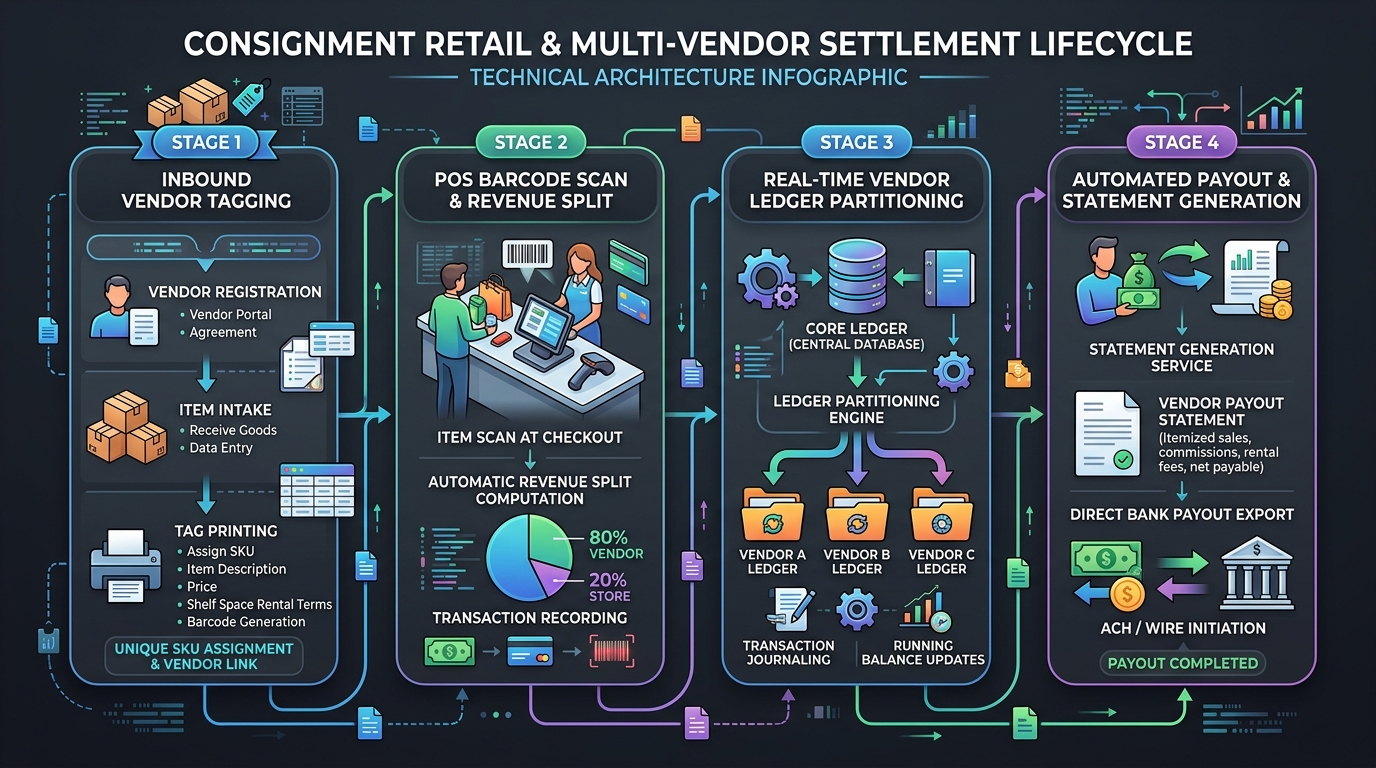
Stage 1: Inbound Intake & Vendor-Tagged Barcodes
When a vendor delivers merchandise to the store:
- Staff register the consignment agreement, specifying fee schedules and direct disbursement bank details.
- Products receive Vendor-Prefixed Barcodes (e.g.,
V12-SKU99), ensuring every physical unit is cryptographically bound to its rightful owner in the catalog ledger.
Stage 2: Unified Counter Checkout with Real-Time Revenue Splitting
At checkout:
- Cashiers scan items seamlessly alongside owned store stock.
- The customer receives a single, professional receipt.
- In the background, the transaction engine evaluates the line-item vendor prefix and partitions the revenue in sub-seconds: crediting the store's operating income ledger while logging the vendor's net payable escrow.
Stage 3: Automated Vendor Settlement Statements
At the close of the settlement cycle:
- With one click, the system compiles comprehensive, itemized PDF Settlement Statements for every vendor.
- The statement transparently reconciles:
$$\text{Net Vendor Payable} = \text{Gross Sales} - \text{Store Commission} - \text{Shelf Space Rental} - \text{Payment Gateway Surcharges}$$
Stage 4: Transparent Vendor Auditing & Batch Disbursals
- Boutique owners export standardized banking files to execute batch electronic fund transfers in minutes.
- Settlement summaries are automatically dispatched via WhatsApp or email, providing transparent transaction audits that build lasting vendor partnerships.
---
3. Operational Comparison: Manual Spreadsheets vs. GeminiPOS Consignment Engine
Operational Dimension · Manual Spreadsheets & Receipt Slips · GeminiPOS Consignment Engine
Monthly Settlement Cycle · 3 to 5 full working days · Zero seconds (One-click batch generation)
Vendor SKU Attribution · Human error misassigns sales · Deterministic barcode-to-vendor mapping
Hybrid Contracts (% + Rent) · Highly complex; prone to calculation slip-ups · Programmatic rule evaluation per agreement
Audit Provenance · Opaque spreadsheets invite vendor distrust · Itemized, timestamped transaction proof
Live Shelf Stock Visibility · Unknown; requires physical shelf counting · Real-time vendor stock balance telemetry
---
4. Best Practices for Consignment Operations
- Mandate Standardized Barcoding at Receiving: Refuse unbarcoded inventory. Every vendor SKU must be registered and tagged before reaching retail display shelves.
- Clarify Card Payment Surcharge Deductions: Explicitly specify in vendor contracts whether electronic payment transaction fees (e.g., credit card or e-wallet fees) are borne by the retailer or deducted from vendor payouts.
- Establish Predictable Settlement Calendars: Disbursing vendor settlements on a rigid, recurring schedule (e.g., the 5th of every month) establishes commercial trust and attracts premier artisan brands.
- Share Sell-Through Analytics with Vendors: Provide vendors with velocity reports showing their best and worst performing products, encouraging them to restock fast-moving lines.
---
5. Conclusion
Consignment retail is a powerful, low-risk growth model when supported by an automated, transparent accounting infrastructure. By unifying vendor attribution, real-time revenue splits, and one-click payout generation within GeminiPOS, store owners eliminate administrative friction, protect commercial relationships, and scale multi-vendor retail networks profitably.
> Ready to streamline consignment tracking and vendor payouts across your stores?
> Discover how GeminiPOS powers modern multi-vendor boutique and consignment operations.
> Explore Supplier & Consignment Features or Schedule an Executive Consultation.
---
> 💡 Related Guide: Discover the complete feature overview, local-first offline architecture, and multi-outlet workflows of our flagship POS system in Malaysia built for modern retail and F&B businesses.